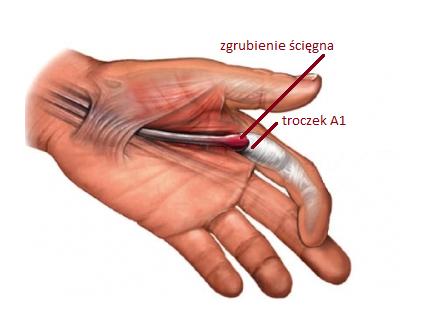
Jamming tendinitis, also known as shooting or crackling finger, is a disease in which, as a result of a conflict between the thickened flexor tendon and the flexor sheath, symptoms of finger skipping develop. Most likely, the development of this disease is a continuation of a congenital stricture within the entrance to the flexor tendon fibrous sheath and secondary to this disturbance in the outflow of lymph from the tendon. The result is a lump and inflammation. Bending your finger initially causes pain when you bend your finger. Often the pain is located within the finger - that is, further than the actual conflict (i.e. at the level of the metacarpus). In more advanced stages, in addition to pain, skipped symptom appears during the finger flexion movement. In the advanced form of the disease, it is impossible to straighten the finger, as it becomes completely jammed, and as a result, it remains in a bent position. Thus, the disease makes it difficult to perform daily activities, limiting the patient's functioning.
Choroba częściej występuje u kobiet po 40 roku życia. Zakleszczające zapalenie ścięgna może powstawać także u osób cierpiących na reumatoidalne zapalenie stawów oraz zmagających się z chorobami metabolicznymi, takimi jak cukrzyca czy dna moczanowa. Czasami pojawienie się schorzenia związane jest z przebytym wcześniej urazem w okolicy palca.
Make an appointment now - to a doctor who specializes in the treatment of shooting finger at our hospital
[title]
[image-intro]
[readmore text="Read more"]{/article}
[title]
[image-intro]
[readmore text="Read more"]{/article}
[title]
[image-intro]
[readmore text="Read more"]{/article}
Diagnosis
The diagnosis is based on an interview and an ultrasound examination of the finger.
Conservative treatment
Conservative treatment is possible, during which the patient is administered anti-inflammatory drugs. However, it is a method applicable to the initial stage of the disease. If there are already difficulties in flexing the finger, ultrasound-guided anti-inflammatory drug administration is offered into the flexor tendon sheath. It helps 50% of the time. In the case of relapse of the disease - possible within a period of several weeks to several years, the administration of an inflammatory drug can also be used, but with a treatment rate that is statistically halved - i.e. about 25%.
It is believed that subsequent injections of the drug may be associated with more side effects, and therefore surgery should be performed.
Non-surgical treatment - percutaneous surgery
Treatment of the shooting finger with this method consists in identifying the structure of the A1 strand under ultrasound guidance and cutting the strand under local anesthesia.
The procedure is performed in a treatment room and takes about 15 minutes. It does not require the application and removal of sutures, dressings and inspection visits. Most often, within 2 weeks, you can return to full load on your hands at work.
Surgery
Treatment of the shooting finger consists in surgical cutting of the cord A1 of the fibrous sheath.
We perform the operation in an operating theater under segmental or local anesthesia. On the inside of the hand, an incision is made, through which the operator reaches the structure, visualizing it, and then cuts it.
The recovery period after surgery is 4-8 weeks.
Sources:
- Kruczyński J., Szulc A., Wiktora Degi ortopedia i rehabilitacja, Wydawnictwo Lekarskie PZWL, Warszawa 2015.
- Turowski Gregory A., Zdankiewicz Peter D., Thomson Grant J., The results of surgical treatment of trigger thinger, The Journal of Hand Surgery 1997, t. 22, s. 145-149.