Carpal tunnel - a minor disease, easily treatable, if left untreated, it causes permanent disability.
The isthmus, or rather the carpal tunnel syndrome, is a condition that results from pinching the median nerve in the carpal tunnel.
Patients with carpal tunnel syndrome complain of pain in the hand and tingling and numbness of the fingers that increase at night. The grip strength and overall efficiency of the limb are also weakened. If left untreated, it leads to permanent nerve damage, i.e. permanent, irreversible disturbances of sensation and atrophy of the hand muscles.
Make an appointment now - with a specialist in carpal tunnel surgery at our hospital
[title]
[image-intro]
[readmore text="Read more"]{/article}
[title]
[image-intro]
[readmore text="Read more"]{/article}
[title]
[image-intro]
[readmore text="Read more"]{/article}
[title]
[image-intro]
[readmore text="Read more"]{/article}
[title]
[image-intro]
[readmore text="Read more"]{/article}
Carpal tunnel syndrome - who is affected
Carpal tunnel syndrome very often affects people who do office work, type long on a computer keyboard or use a mouse - journalists, graphic designers, writers. Often, carpal tunnel syndrome also suffers from people who constantly perform the same repetitive movements that overload their wrists and put pressure on the median nerve, e.g. when working in a barbershop, working on a production line, stacking bricks, packing items. Carpal tunnel syndrome can also occur in people who are physically active or actively participate in some sports - for example, cycling, playing tennis or any other activity that requires uniform, repetitive hand movements with the involvement of the wrist. Musicians who practice instruments for many hours can also suffer from this ailment. In a few percent, the disease is caused by badly healed injuries, such as fractures or sprains within the wrist, as well as degenerative changes or hormonal disorders. Carpal tunnel syndrome usually affects people over 40 and is much more common in women than in men.
Carpal tunnel syndrome - diagnosis is the key
What are the most common symptoms of carpal tunnel syndrome? The first and primary symptom that patients experience is numbness and pain in the fingers. In the initial stage of the disease, the numbness of the fingers is not very bothersome. Often, patients report that they just slept badly and their arm is simply numb, or that they have held their arm in an uncomfortable position for a long time and therefore become numb. After some time, the numbness becomes more frequent and the pain is more and more severe, radiating to the forearm and even the shoulder. Patients lose grip strength, have problems with holding small objects such as glasses or pens in their fingers. It is also difficult for them to make a precise drawing or cut a piece of paper with scissors. Carpal tunnel syndrome causes great discomfort and sometimes even makes everyday existence impossible.
Modern treatment
Treatment of the carpal tunnel syndrome - minor surgery. Immediately afterwards, the median nerve begins to heal
Surgical treatment of the carpal tunnel is the only surest, fastest and safe way to cure the condition.
From the moment of introducing microsurgical techniques based on endoscopic and microscopic visualizations into treatment, the operation ceased to be a large procedure under anesthesia, excluding the hand from functioning for several months.
Thanks to the microsurgical techniques we use, it has become a minor procedure performed under local anesthesia, guaranteeing the efficiency of the hand after several days.
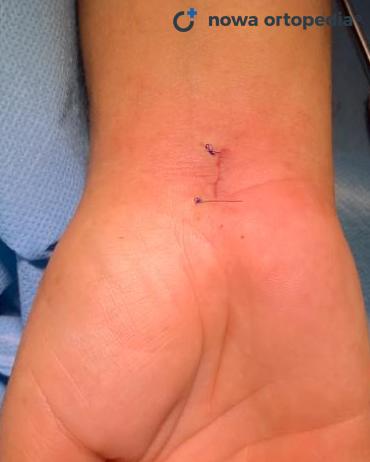
We perform the procedure from a small incision in the wrist area and regardless of the previously chosen method - endoscopic or microsurgical with optical magnification, we perform full release of the nerve from pressure.
We will finish the operation with 1-2 absorbable sutures that you do not need to remove,
From there, your nerve begins to heal. . The entire stay in the hospital lasts a maximum of 1 hour.
The slight invasiveness of our modern surgical techniques does not require plaster or limb immobilization.
Rehabilitation
Rehabilitation consisting of gentle massage and simple hand exercises according to the instructions of our physiotherapists should start as soon as possible after the surgery. The time of full recovery and return to work is an individual matter - depending on the nature of the work performed, this time is from 2 to 8 weeks. Usually, however, patients return to work just 3 weeks after the surgery.
Symptoms of the carpal tunnel syndrome
What are the most common symptoms of carpal tunnel syndrome? The first and primary symptom that patients experience is numbness and pain in the fingers. In the initial stage of the disease, the numbness of the fingers is not very bothersome. Often, patients report that they just slept badly and their arm is simply numb, or that they have held their arm in an uncomfortable position for a long time and therefore become numb. After some time, the numbness becomes more frequent and the pain is more and more severe, radiating to the forearm and even the shoulder. Patients lose grip strength, have problems with holding small objects such as glasses or pens in their fingers. It is also difficult for them to make a precise drawing or cut a piece of paper with scissors. Carpal tunnel syndrome causes great discomfort and sometimes even makes everyday existence impossible.
How carpal tunnel syndrome develops
The carpal tunnel is a fairly narrow tunnel with the median nerve and flexor tendons inside the fingers. The tunnel is limited at the bottom and sides by bones - and at the top by the transverse ligament of the wrist. If inflammation occurs in the carpal tunnel, the sheaths covering the tendons become swollen, or the transverse ligament is overgrown - it becomes too tight. The result is pressure on the nerve fibers. As a result of pressure, degenerative changes occur and nerve functions are reduced. If the pressure on the median nerve is removed, the nerve will regenerate and return to full functionality over time.
Important information
| Duration of the procedure (depending on the method) | 20-40 minutes |
| Basic tests required for the procedure | not necessary |
| Anesthesia | local |
| Hospital stay | up to 1 hour |
| The period of significant dysfunction | 2 weeks |
| The period of limited dysfunction | 6 weeks |
|
Removal of stitches |
2 weeks not always necessary |
|
Change of dressings |
every 3-4 days |
| Contraindications to the procedure | blood clotting disorders |
Frequently asked questions about carpal tunnel syndrome:
Symptoms of carpal tunnel syndrome include numbness in the fingers, tingling in the hand, pain in the hand and forearm, which often occurs at night, weaker grip strength, difficulty in performing precise tasks or holding small objects.
The most vulnerable to carpal tunnel syndrome are people who work for a long time at the computer, on the production line, musicians, cyclists, seamstresses - people who often repeat the same movements of the wrist.
The doctor decides whether surgery is necessary - in the early stages of the disease, surgery may not be necessary. However, it should be emphasized that surgical decompression of the median nerve gives the best treatment results.
The doctor decides whether surgery is necessary - in the early stages of the disease, surgery may not be necessary. However, it should be emphasized that surgical decompression of the median nerve gives the best treatment results.
The procedure is short-lived - the operation itself takes 10-15 minutes. Patients usually return home on the same day after surgery.
Depending on the patient's condition and the type of work performed, return to overseas activity is possible in the period between 2 and 8 weeks after the surgery. Usually, patients return to work 3 weeks after the surgery.