Arthroscopy is a method of joint surgery (arthroscopy, scope - viewfinder), which consists in introducing miniature tools and a high-resolution magnifying camera (arthroscope) into the joint. The surgeon makes small incisions of the body integuments (approx. 8 mm), thanks to which the procedure is much less invasive compared to the classic open hip surgery. The patient stays shorter in the hospital, convalescence after the procedure is faster, and postoperative scars are minimal. The word arthroscopy does not indicate a specific purpose of the procedure, but only defines the method of performing the operation by means of a joint endoscopy.
Make an appointment now - see the doctors in the hospital for an arthritis of the hip in our hospital
[title]
[image-intro]
[readmore text="Read more"]{/article}
Pain in the hip joint
The hip joint consists of the spherical head of the femur and the acetabulum formed by the pelvic bones. Both articular surfaces are covered with hyaline cartilage. Additionally, the acetabulum of the hip joint is filled around its perimeter with a fibrous labrum, which improves the stability of the hip. The joint is surrounded by a bag reinforced with ligaments. Moreover, the hip has an intra-articular ligament of the femoral head.
Hip discomfort or pain is most often the result of osteoarthritis or femoral conflict, but it can also be the result of acute damage to joint structures or pathology of the muscles surrounding the joint.
Symptoms of a problem localized in the hip joint include:
pain in the groin area,
limitation of the mobility of the hip joint - especially bending and internal rotation.
hip pain when walking,
the feeling of jumping in the hip
audible clicks when making movements with the lower limb,
impression of hip instability.
Abnormalities in the internal structure of the joint are more common in people with a history of hip dysplasia, sterile necrosis of the femoral head or after injuries. Earlier degeneration of the hip joint on the basis of existing abnormalities may occur in athletes training martial arts, gymnasts, footballers, runners. It is associated with the performance of sudden movements in the hip and the work of the loaded joint in the final range of motion.
When is hip arthroscopy performed?
In order to plan effective treatment, information on the location of an overloaded or damaged structure is needed. Most hip injuries can be detected and surgery planned based on X-rays, magnetic resonance imaging of the hip (MRI) and clinical examination. On the other hand, imaging diagnostics does not always enable the precise determination of the cause of all ailments - often intraoperative additional lesions are discovered (most often related to the labrum), which were not visible in imaging tests. MRI with contrast is an examination that increases the chance of visualizing labrum or cartilage damage, but is still not 100% effective in diagnosis.
Hip arthroscopy allows not only to diagnose the cause of pain, but most of all it allows to repair the elements of the joint in order to improve its function and prevent the rapid progression of degenerative changes.
Arthroscopy is performed in people aged 21-65, whose hip joint is in the early stages of degenerative changes. There is no point in performing arthroscopy when the hip is badly damaged and has already stiffened.
Indications for hip arthroscopy
Hip arthroscopy is performed in patients who, on the basis of clinical examination and imaging diagnostics, have initially diagnosed joint damage, e.g. damage to the labrum, articular cartilage or other pathology treatable by arthroscopy.
Acetro-femoral conflict
The most common indication for hip arthroscopy is the Femoro Acetabular Impingement (FAI). To put it simply, it is a form of a mismatch between the shape of the femoral head and the acetabulum, which results in damage to the labrum, cartilage and the gradual development of joint degeneration with pain and limitation of its mobility.
The initial diagnosis of the femo-acetabular conflict is performed by a test which consists in positioning the limb in 90 degrees flexion, and then on the maximum addition and internal rotation of the hip with pressure on the limb axis. This creates shear forces on the damaged labrum and causes pain.
The following types of acetabular-femoral conflict are distinguished:
1.Pincer - type impingement - the formation of bone outgrowths along the edge of the acetabulum of the hip joint, which significantly increases the risk of damage to the labrum,
2. Cam - type impingement - the shape of the femoral head is abnormal, so that the head cannot move smoothly in the acetabulum,
3. Mixed - Both "Pincer" and "Cam" distortions occur.
All forms of this conflict can and must be treated arthroscopically. If this is not done early enough, the risk of developing hip degeneration rapidly increases significantly. Advanced degenerative changes are ultimately treated with hip arthroplasty - a complete hip replacement.
Other indications for hip arthroscopy
Other indications for hip arthroscopy may include:
the presence of free bodies in the pond,
disruption of the ligament of the femoral head,
sterile femoral head necrosis (early stage),
hip instability due to ligament failure or labrum,
rinsing the joint in case of purulent inflammation,
removal of the hypertrophied synovium of the hip joint,
Pipkin femoral head fractures,
changes in the hip caused by gout or chondrocalcinosis.
repair treatments for the hip rotator cuff muscles and the iliopsoas muscle.
Preparation for arthroscopy
Rehabilitation preparation not only significantly facilitates improvement after surgery, but also allows you to avoid it. The pain in the hip in the course of the aceto-femoral conflict does not result directly from the abnormal shape of the joint, but is the result of the accumulation of overloading of the joint structures, contracture of the joint bag and imbalance of the tension of the periarticular tissues. Pain relief can be achieved with the help of various techniques of manual therapy and kinesiotherapy.
Hip arthroscopy
In the case of cam-type impingement, the operation involves changing the shape of the femoral head contour at the point where it joins the neck. In the presence of a pincer - type impingement, it is sometimes necessary to cut the labrum, change the edge of the bony acetabulum and sew it back on with special anchors. Sometimes it is necessary to perform both procedures at the same time. The surgeon assesses the range of movements in the hip joint on an ongoing basis, at which the operated area is not injured.
Despite advanced diagnostics, including magnetic resonance imaging with contrast, very often only intraoperative damage to the labrum or cartilage is discovered. Therefore, the surgeon performing arthroscopy must have appropriate skills in the event of various types of joint damage. The operating theater should also be equipped with back-up facilities for such eventualities.
The duration of hip arthroscopy is 1 to 2.5 hours. Hip joint operations are most often performed under general anesthesia, exceptionally, peripheral anesthesia can be used while maintaining the patient's awareness. Pain in the postoperative period is acceptable with the use of basic painkillers.
Patient positioning for hip arthroscopy 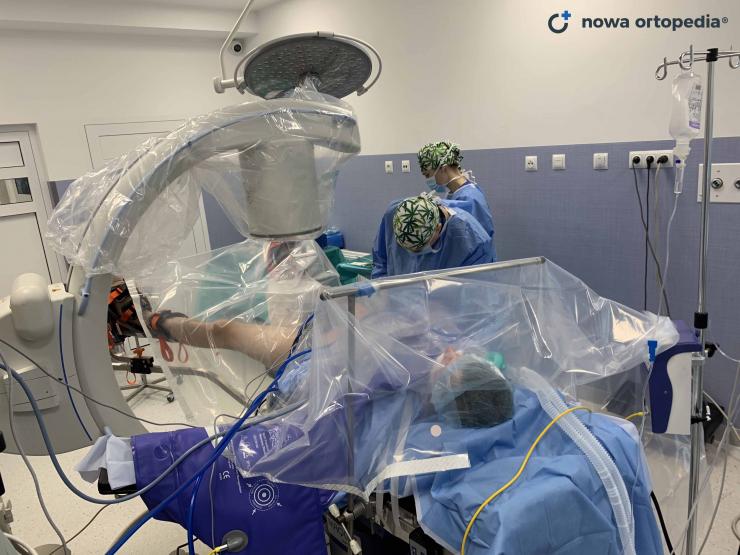
Extraction table for hip arthroscopy 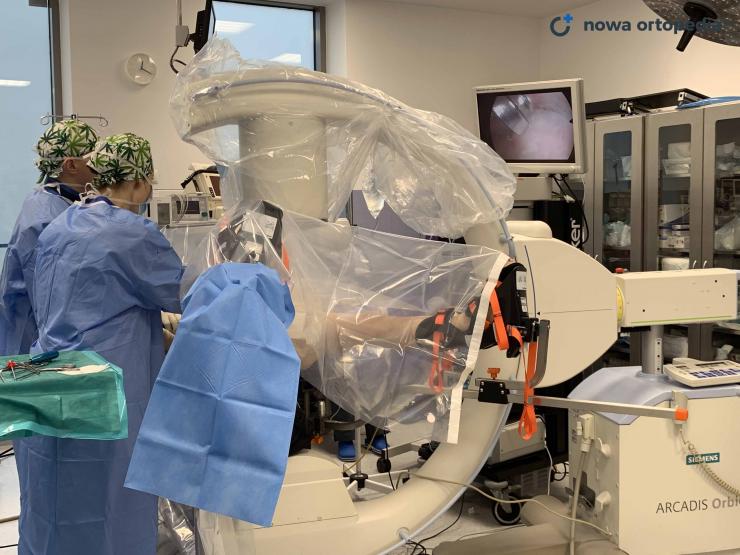
Intraoperative X-ray with hip arthroscopy 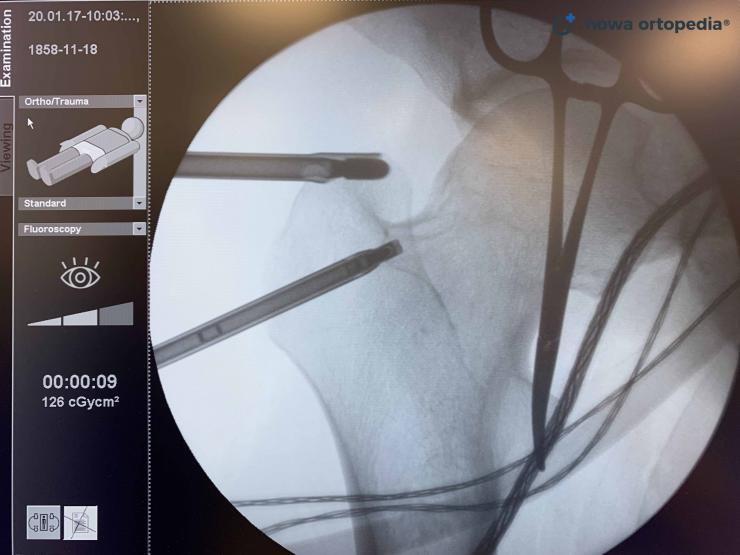
Rehabilitation after hip arthroscopy
The rehabilitation plan depends on the extent of the damage found during the procedure and the extent to which the joint was repaired during the operation. The rehabilitation plan is refined after the procedure, which requires close contact between the physiotherapist and the surgeon.
Rehabilitation after hip surgery is aimed at recovering the limb's fitness as quickly and safely as possible. The physiotherapist selects the appropriate methods of therapy to restore neuromuscular coordination and increase muscle strength, which is to improve the functional stability of the joint and protect the hip against further overloads.
After the procedure, the limb can be placed on a special splint, which enables slow and passive movement within the range of motion established intraoperatively. Swelling of the hip joint and surrounding area disappears very quickly due to the close proximity of large blood vessels and the heart. Initially, rehabilitation includes isometric exercises, and then active in consultation with the doctor. During the first week, the patient unloads the operated limb with the use of elbow crutches. We start the gradual loading of the operated leg with the weight of the body, when the doctor allows it. An indicated form of hip rehabilitation is a stationary bike with a low load. Returning to full activity depends on the extent of the surgical repair of hip injuries, patient involvement in the rehabilitation process and the form of activity the patient wants to return to. As a rule, the recovery time is 2 months.
In the presence of chronic overload lesions or repair of large lesions, rehabilitation takes much longer and does not always allow for full recovery - the operated limb may remain functionally less efficient compared to the non-operated one.
Hip arthroscopy in Cracow
At the Dworska Hospital, the doctor who qualifies for the procedure always performs this procedure. In the "world of the National Health Fund" this is not always possible. Before the operation, the doctor discusses the course of arthroscopy with the patient and explains exactly what and to what extent can be repaired in the hip.
Even 10 years ago, no one in Poland performed arthroscopy of the hip joint. Currently, in order to learn how to perform such an operation technically well, one needs to spend a lot of time in training centers outside our country. The learning curve for hip arthroscopy is more difficult than for knee and shoulder arthroscopy. At Dworska Hospital, hip surgeries are performed by experienced surgeons with many completed foreign training courses.
Hip arthroscopy is carried out on very modern equipment with the use of optics and HD image. The equipment of the operating theater is adapted from scratch to the types of procedures performed and is co-created by working doctors.
There are physiotherapists on site who teach in the first 6-12 hours how to safely use the operated limb - in accordance with the operator's instructions. They assist you in getting up for the first time and teach you how to do basic exercises after hip surgery.
Important information
| Duration of the procedure (depending on the method) | 1 - 2,5 hours |
| Basic tests required for the procedure | tab - preparation for surgery tab |
| Anesthesia | subarachnoid or general |
| Hospital stay | 8 - 12 weeks |
| The period of significant dysfunction | 2 - 3 weeks |
| The period of limited dysfunction | 4 - 12 weeks |
| Removal of stitches | 12 - 16 days |
| Change of dressings | every 3 - 4 days |
| Contraindications to the procedure | Degeneration of the third and fourth degree |
Frequently asked questions about hip arthroscopy
Hip arthroscopy is a minimally invasive procedure, which allows you to reduce the time spent in hospital up to one day after surgery. This is an advantage of arthroscopy compared to open surgery, after which the patient spends several days in the hospital. Please note that only selected hip treatments can be performed during arthroscopy. The decision on qualification for a given type of surgery is made by the operator surgeon.
Hip arthroscopy is a technically very difficult procedure, so it is worth choosing an operator who has experience in performing this type of procedure. In addition, physiotherapists should be present in the hospital, who teach to get up and walk after the procedure, show exercises after the surgery and provide important tips on the further rehabilitation process.
Exercises are selected individually by a qualified physiotherapist in consultation with the surgeon performing the operation. The aim of the exercises is to restore the possible hip function, painless walking and resumption of activity. The exercises consist mainly in improving neuromuscular coordination and gradual strengthening of the muscles of the pelvic girdle.