Dupuytren's disease, also called Dupuytren's contracture, is a disease of the subcutaneous tissue, specifically the palmar fascia, which causes disturbances in the ligamentous and joint apparatus of the hand. The picture of flexion contracture of the fingers - usually the fourth and fifth - is characteristic. This ailment mainly affects men over 50 and in the advanced stage of the disease severely limits the functioning in everyday life. In the early period, patients can choose conservative (non-surgical) treatment in the form of physiotherapy - exercise, massage and physical therapy. Later, surgery or treatment with collagenase injection is much more effective. In our center, it is also possible to perform a partial percutaneous release - in the case of severe IV degree deformation as the first stage of treatment or as a minimally invasive procedure in people with contraindications to full surgery.
Make an appointment now - with a doctor who specializes in the treatment of Dupuytren's disease at our hospital
[title]
[image-intro]
[readmore text="Read more"]{/article}
[title]
[image-intro]
[readmore text="Read more"]{/article}
[title]
[image-intro]
[readmore text="Read more"]{/article}
[title]
[image-intro]
[readmore text="Read more"]{/article}
What is Dupuytren's Contracture?
The essence of the disease is the progressive fibrosis of the palmar fascia, which causes flexion contracture of the fingers - usually the ring and small fingers, and blood supply disorders in the hand. The above changes are caused by the excessive production of collagen, i.e. a building protein in our body, found, inter alia, in the connective tissue of which the palmar and plantar fascia (on the sole of the foot) are built. Over time, the disease process not only affects soft tissues, but also includes bone structures, i.e. we observe contracture in the joint within the fingers. The changes concern the metacarpophalangeal joints as well as the proximal and distal interphalangeal joints.
Mainly men over 45 are at risk of developing the disease, and the risk increases with age. Other contributing factors are hyperlipidemia, alcohol and cigarette abuse, epilepsy, injuries, diabetes, and specific work that overloads the hands. Genetic conditions, i.e. the course of the disease in the family, are also very important.
The diagnosis is made on the basis of an interview and palpation - the doctor can feel thickenings and bands under the skin resulting from aponeurosis and small nodules. The degree of finger contracture is also measured, the greater it is, the greater the likelihood of using surgical treatment. Imaging tests (X-ray, ultrasound of the hand) are generally not applicable to the detection of Dupuytren's disease. Other causes of such ailments should also be ruled out, e.g. brachial plexus (pressure on the nerve roots most often resulting from discopathy of the cervical spine, which radiates pain and numbness in the fingers), hand overload due to work, lumps of other origin, etc. Depending on the severity of the disease, there are four stages.
How to treat Dupuytren's disease?
The most effective and popular method of treating contracture is surgery, while conservative, i.e. non-surgical, treatment is also used in the early stages of the disease.
Nonsurgical treatment
The least popular (mainly due to the price of the drug) is treatment by means of a precise subcutaneous injection of collagenase (an enzyme), which is aimed at digesting the fibrotic bands of the palmar fascia. The next day after the injection, redression is performed by completely tearing the fibers, straightening the fingers and immobilizing them in the splint for another 2 weeks. This procedure is called an enzyme aponeurotomy.
Transdermal release with a needle
It is the least invasive technique that involves the percutaneous incision of fibrous strands in several places. The procedure is performed under local anesthesia on an outpatient basis. Instead of a postoperative wound, there are point marks left after puncture with a needle, which disappear after a few weeks. This method can be used as the first stage of heavy 3rd and 4th degree contractures - leading to partial stretching of the fingers. It may also be the only, final treatment in people with contraindications to surgery or in patients with less requirements as to the degree of cure, feeling lost under the skin.
The hand before the operation 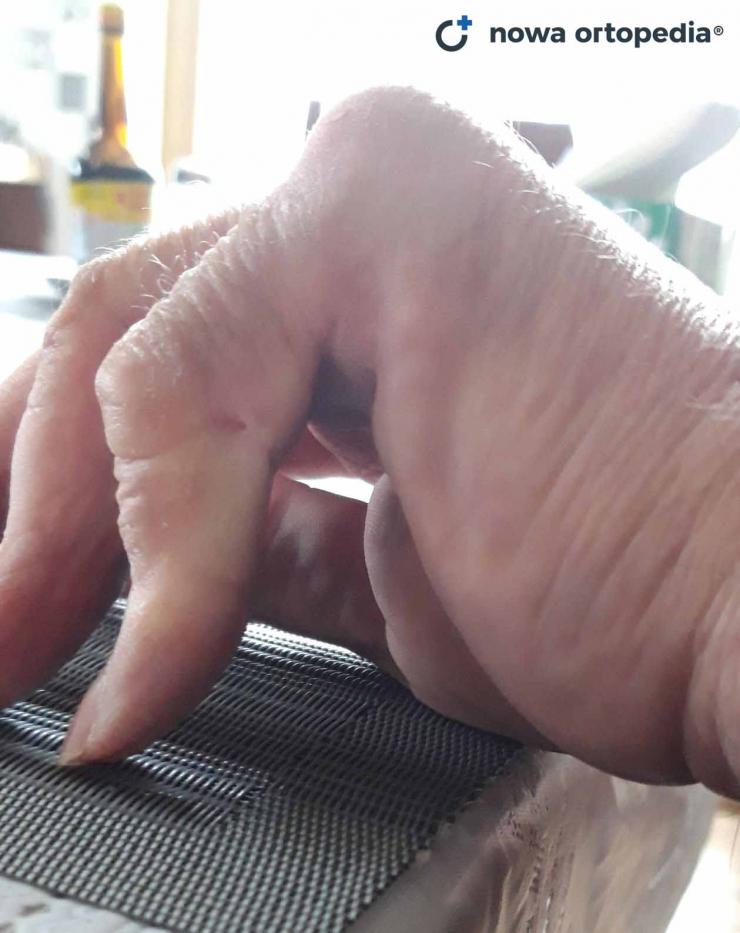
The same hand 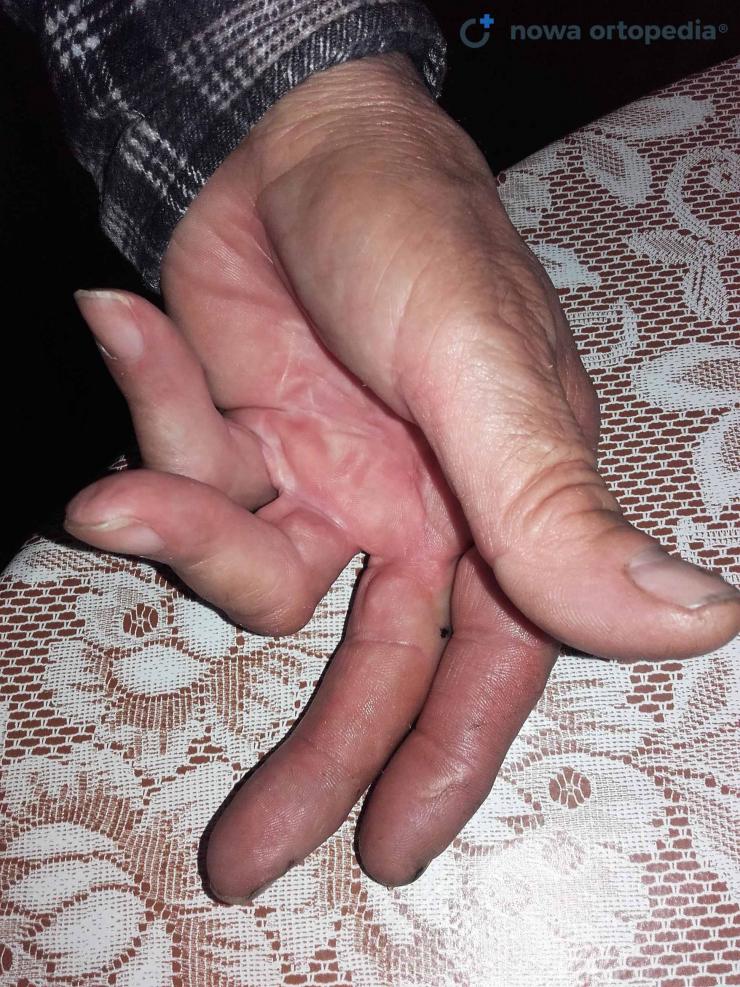
View of the fibrous strands of the same hand 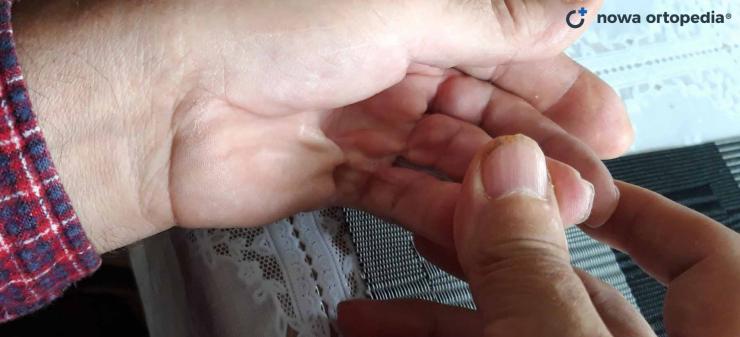
Local anesthesia in a treatment room 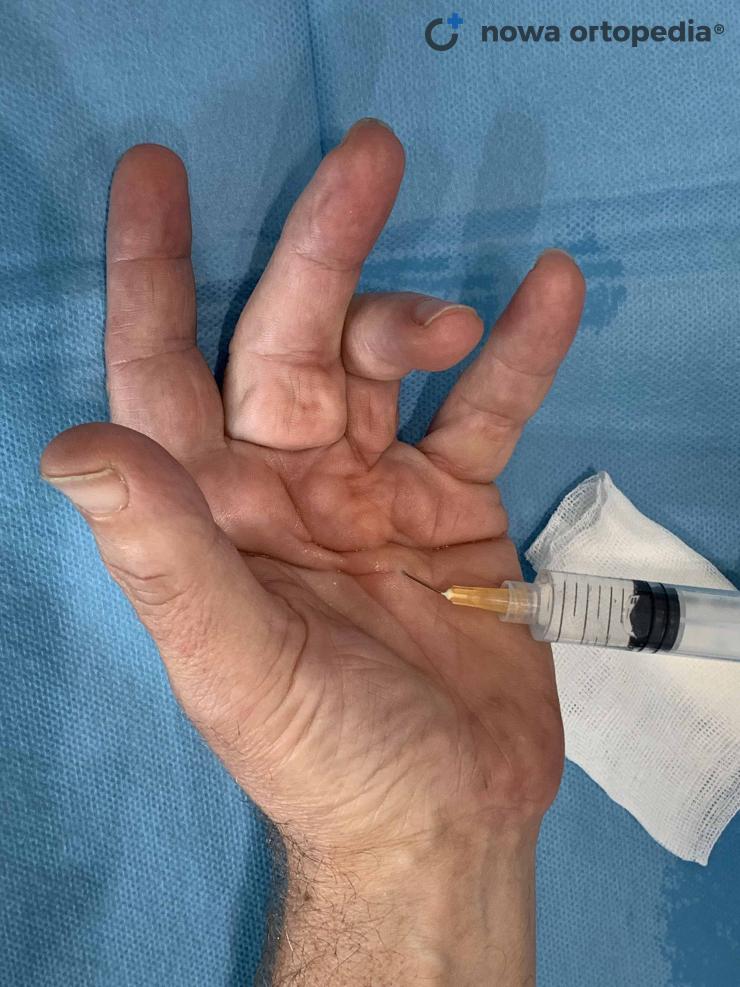
The result 2 weeks after the surgery of the percutaneous release under local anesthesia 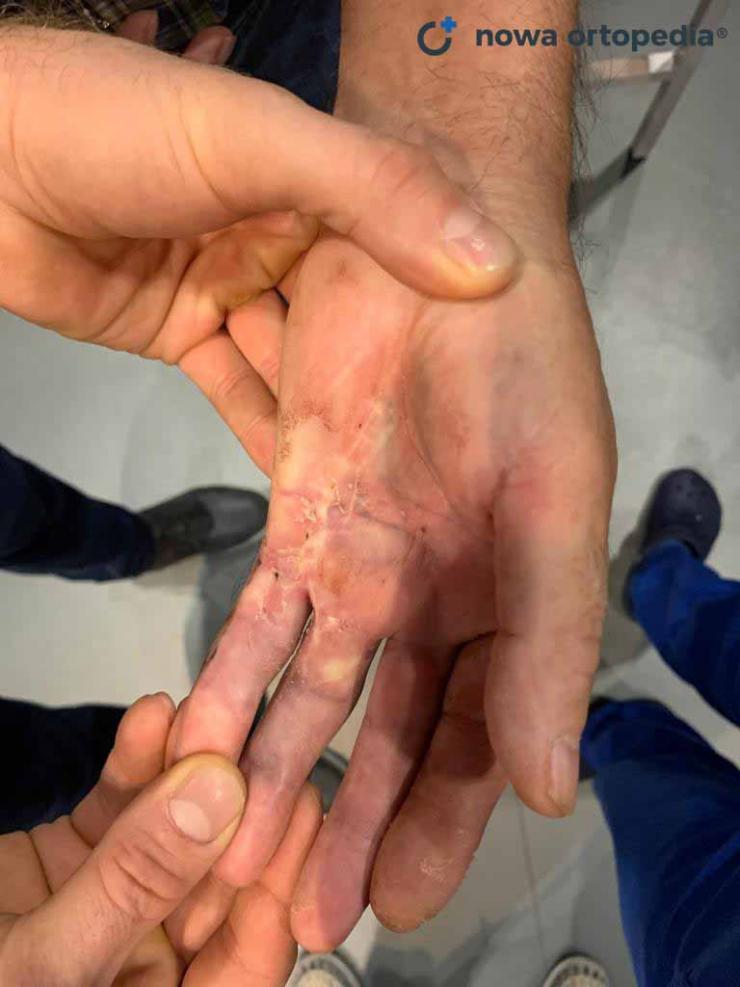
The same hand after 2 weeks 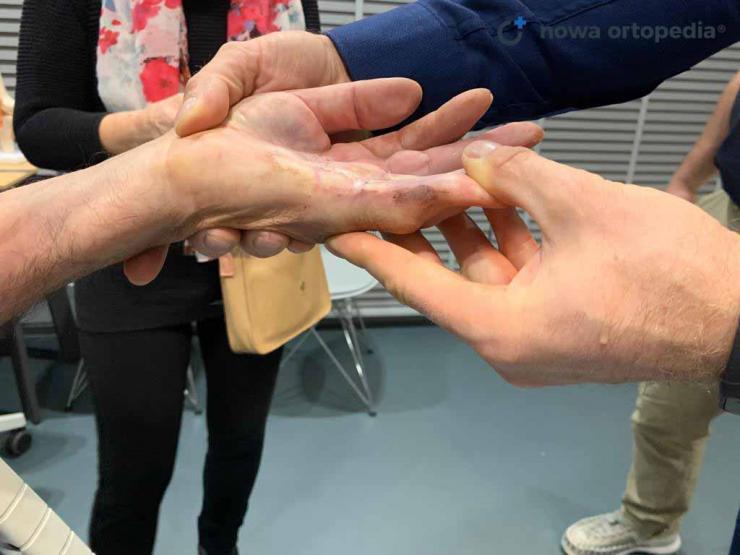
The same hand after 2 weeks 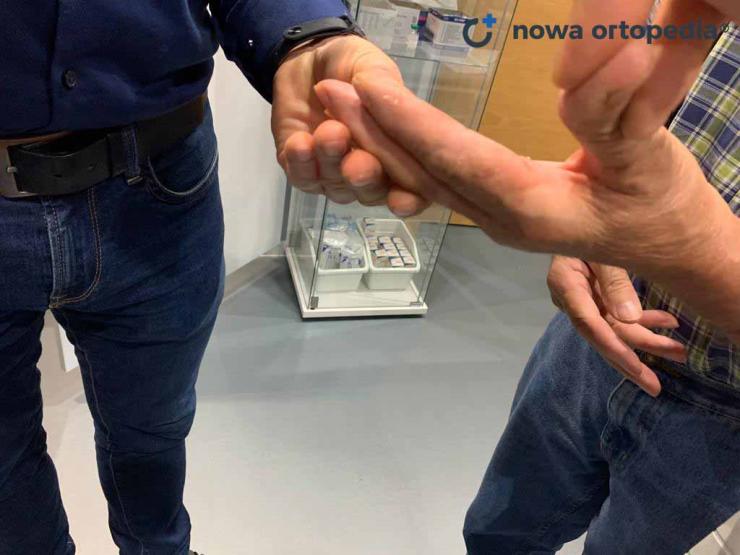
Physiotherapy can also be helpful - deep massage and fascial techniques for the area of the forearm and hand and even the entire upper limb, exercises for stretching, relaxing and maintaining the range of motion, as well as ultrasound, radiation and laser therapy.
The use of steroids and gamma-interferon is sometimes recommended as a pharmacological treatment.
Surgery
Various surgical techniques are used in the course of Dupuytren's disease. Surgical treatment is the so-called gold standard, which is the most popular and effective way of treating a given disease. The method of treatment is decided by the surgeon after a clinical examination and discussing the types of treatment with the patient.
Open aponeurotomy
It is a development of the above-mentioned procedure, the difference is a more extensive cut - making a few small incisions from which the scarred strands are removed. The treatment can only be effective in less severe contractures.
Fasciotomy
This is a more advanced method. During this operation, the surgeon makes an incision in the hand and diseased fingers, and then removes the thickened connective tissue under the skin. The procedure is performed under peripheral anesthesia or an axillary block - the patient is conscious all the time. Fasciotomy is a very effective method and the risk of relapse is low.
Living with Dupuytren's Disease
The course of Dupuytren's disease is not uniform and sometimes it makes everyday activities very difficult. In case of suspicion of the symptoms mentioned in the text, it is worth going to a specialist doctor who will treat contracture using all methods.
Important information
| Duration of the procedure (depending on the method) | 20 -120 minutes |
| Basic tests required for the procedure | are not required or essential - in case of full release |
| Anesthesia | forearm block, local or axillary block |
| Hospital stay | 3-6 hours after surgery |
| A period of significant dysfunction | 12 - 21 days |
| A period of limited dysfunction | 3 - 8 weeks after surgery |
| Removal of stitches - first visit | 12 - 16 days or not applicable (percutaneous method) |
| Change of dressings | every 3 - 4 days or not required for percutaneous release |
| Contraindications to the procedure | infection |
Frequently asked questions about the treatment of Dupuytren's contracture:
Treatment of Dupuytren's contracture should be selected by a specialist physician to suit the individual needs of the patient. After the correct diagnosis has been made, the patient is usually referred to surgery, which is minimally invasive, well-tolerated by patients and gives long-term, satisfying results that improve the patient's quality of life. After the surgery, rehabilitation procedures should be implemented, aimed at maintaining the range of motion in the joints, loosening the postoperative scar and accelerating the recovery. I use orthopedic equipment in the form of a splint that keeps the fingers in extension to consolidate the effect.
The course of the disease is usually unnoticeable in the early stages. Only later do thickened bands of connective tissue and palpable nodules appear under the skin. The bending contracture of the fourth and fifth fingers is characteristic, i.e. the ring and the small fingers. There are problems with straightening the fingers during various activities, and with time straightening is no longer possible. The earlier we see a doctor, the better the prognosis and the possible full recovery.
Each surgical procedure interferes with our body and carries a certain risk. It is worth choosing a proven facility where the patient is qualified for the procedure and operated by an experienced surgeon. The availability of a physiotherapist who, in consultation with a doctor, will conduct manual therapy and teach you appropriate exercises is also important.