Know your hips before it's too late!
Degenerative conditions of the hip are quite common ailment. Mainly elderly people complain about it. But you can predict the likelihood of hip degeneration in advance. What are the causes of this painful disease, what to do to stop it, delay it, and if it becomes commonplace, what treatment will be most effective and adequate to the stage of the disease.
Hip endoporthesis - the last resort for aching hips
Hip prosthesis is a procedure used in the treatment of advanced degenerative changes in the hip. It is effective and allows people who have almost stopped walking to move around on their own. However, this procedure causes significant limitations in patients.
Therefore, active people suffering from hip pain ask themselves and orthopedists the following questions: but is it possible to play tennis after it? Can I run, ski, jump, play volleyball or basketball with a hip replacement? And if so, how quickly will the prosthesis loosen, forcing it to be replaced with a larger one, requiring more extensive intervention? How many such exchanges (called revisions) are we able to perform (as orthopedists) and how many can we endure (as patients)? These questions make you ask the earliest age to propose / agree to an endoprosthesis ??? Is there anything we can do to avoid it or even postpone it? What most often leads to a hip replacement?
The femoral acetabular conflict (FAI) is an increasingly recognized problem
It turns out that 50%, and according to some publications, even up to 70% of currently installed hip prostheses are patients suffering from FAI at an earlier age, i.e. the femoral acetabular conflict. What is? It is possibly the most common pathology causing groin pain in adolescents and young adults (aged 12-70?).
When is the FAI formed?
FAI is created when there is excessive friction in the hip joint. This friction is caused by improper joint structure or bone eruptions that reduce the range of motion. The change in the shape of the femoral head and acetabulum, caused by growths, causes increased friction which leads to hip pain damage. FAI lesions include articular cartilage (smooth white cover of the ball and acetabulum) and the labrum. This is due to increased friction when moving properly in the hip. If left untreated, the conflict can lead to the complete wiping of the cartilage over time. As a result, the bare femoral head bone rubs against the acetabular bone. This condition is called arthrosis (osteoarthritis).
Some FAI statistics
Americans have studied their teenage soccer players and it has been found that it affects 50% of girls and 70% of boys who play football. It is similar in the case of other sports that require kicks, squats and hip rotation, such as martial arts, basketball, hockey, weightlifting, etc. But not only sport leads to FAI, but also hip disease in adolescence, hard physical work and, according to some authors, also sedentary lifestyle. So we are dealing with something that, since the term was first used in the late 1990s by Professor Ganz from Switzerland, quite quickly became a common problem. If we add the fact that people affected by aceto-femoral conflict tear about 10 times more often the anterior cruciate ligament and are more easily injured in the knees and ankles, it will not be surprising that over the last 10 years we have been dealing with an avalanche of interest in the subject both among orthopedists and patients.
Two types of acetabular-femoral conflict
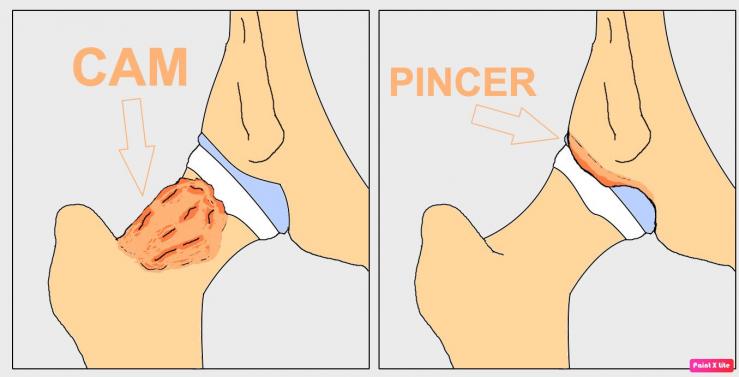
But let's go back to the acetabular-femoral conflict itself. Two types can be distinguished: cam and pincer.
CAM (cam type): The distortion mainly affects the head and neck of the femur. These can be osteophytes formed at the transition of the head and neck of the femur, deformity resulting from diseases of the hip in adolescence, such as juvenile exfoliation of the femoral head. As a result of abnormal hip operation, the labrum and cartilage are damaged. It affects men more often.
PINCER (pincer type, pincer type): the deformation mainly concerns the acetabulum. The acetabular superstructure is characteristic, so that the acetabulum becomes "too deep" and excessively covers the femoral head. The effect of this is the jamming of the labrum. A variation of pincer deformity is abnormal posterior acetabular rotation (acetabular retroversion). It affects women more often.
MIXED: Most femoral acetabular conflict diagnoses are a combination of a cam deformity and a pincer.
What are the concerns of the acetabular-femoral conflict?
Groin pain associated with hip movement
Pain in the anterior (groin), lateral (trochanter and area) and posterior hip (buttock) area
Pain can be described as either dull or sharp
Complaints about blocking, jumping and hooking in the hip
Pain may be deep in the hip or in the groin area after prolonged sitting or walking
Difficulty climbing
Restriction of mobility at the hip
Lower back pain
Pain in the buttock or upper thigh, sometimes radiating up to the knee (especially the inside of the knee)
Knee pain
What are the FAI risk factors?
A risk factor is something that makes you more likely to have a condition. The risk factors for FAI (femur-acetabular conflict) may include:
Sports, mainly soccer, martial arts, weightlifting, hockey, basketball and other sports that require squats, pitting, kicks, etc.
Physically hard working people
Often repetitive hip flexion
Congenital hip dislocation or dysplasia
Anatomical abnormalities of the structure of the head and neck of the femur
Juvenile exfoliation of the femoral head and Perthes disease
Hip injuries
Arthritis
Diagnosis of hip problems
Diagnosis of hip problems should be performed by an orthopedic surgeon. In the case of young people (15-65 years of age), the best address is a doctor specializing in hip diseases, who offers NOT ONLY hip prostheses in his portfolio.
Hip problems often cause groin pain initially. It also happens that hip disease coexists with inguinal hernia. Often, those affected by this problem go to a general surgeon. Therefore, a good solution is a consultation of a 3-person therapeutic team: orthopedist-physiotherapist-general surgeon specializing in groin and hip problems.
The following are important in diagnostics:
correctly collected interview
clinical trial
imaging tests: x-ray, magnetic resonance imaging of the hip (MRI) and computed tomography (CT).
Conservative treatment
Conservative treatment of the hip is non-surgical therapy, mainly physiotherapy. Non-surgical treatment is not able to affect the abnormal structure of the hip and the resulting damage, but very often it significantly reduces or removes pain and improves mobility.
Types of conservative therapies
• rest
• change and limitation of some motor activities (mainly including learning pelvic tilt)
• anti-inflammatory and pain relieving drugs
• physiotherapy
• intra-articular and surrounding tissue injections
When should an orthopedic surgeon start treating the hip?
Surgical treatment should be considered when conservative treatment has not brought improvement. Nowadays, most cases of femo-acetabular conflict can be treated endoscopically using hip arthroscopy.
Hip arthroscopy
Hip arthroscopy is a surgical technique that has revolutionized the treatment of the common problem of hip pain. Applied at an early stage of the disease, it often allows to postpone or even avoid the hip replacement surgery.
During the procedure, the orthopedist introduces a camera and arthroscopic instruments through a few small skin incisions.
Arthroscopic hip repair techniques were developed relatively late due to the extremely compact structure of the hip joint.
Only after using the lift can the head of the femur slide out of the acetabulum, which creates space for the insertion of tools. An additional difficulty is the extremely deep location of the hip joint hidden in the mass of muscles and other tissues surrounding the hip joint.
This makes hip arthroscopy an extremely demanding procedure. For proper hip arthroscopy, specific tools are required, often dedicated only to this procedure, and the orthopedist's extensive experience in performing endoscopic procedures.
During the procedure, the orthopedist performs the removal of bone growths, repair of the labrum, if possible, or the removal of unstable fragments in cases of irreparable damage, and repair of acetabular cartilage.
Hip degeneration prophylaxis, i.e. before you look for the last resort
Each of us wants to enjoy health as long as possible. The ability to move independently and painlessly in old age should be one of the goals of every human being. It is worth knowing a few rules of conduct that allow us to walk into old age. Here they are
take care of your weight and diet, too much strain on the joints leads to faster development of degenerative changes
move, stand and sit the right way - posture defects, gait disturbances and an abnormal posture while sitting are the most common causes of pelvic anterior tilt, the control of which is currently seen as a chance to reduce the incidence of femoral acetabular conflict
service your locomotor system - just as we brush our teeth every day, we should start the day with a properly done 5-15 minute warm-up and end the day with 5-15 minutes stretching and rolling