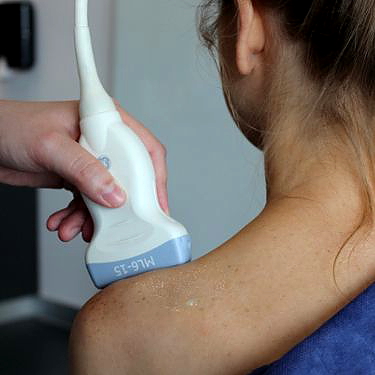
The shoulder ultrasound is used to diagnose pain, limitations in the range of mobility in the shoulder joint and the states of reduced strength of the muscles controlling the shoulder-brachial complex. Shoulder ultrasound is often performed when pathology is suspected within the tendons of the rotator cuff, and has a diagnostic value comparable to that of magnetic resonance imaging. A dynamic ultrasound examination of the shoulder, which takes place while moving the arm, is especially valuable. It enables the evaluation of tissue images in real time, highly correlating with the clinical symptoms reported by the patient.
Shoulder sonosurgery involves a number of procedures performed under ultrasound guidance. Thanks to this, it is possible to safely administer the drug exactly to the affected area. These procedures may also aim at aspiration of synovial fluid (joint puncture) or treatment of gelatinous cysts in the shoulder joint area.
Make an appointment now - to the doctor who performs shoulder ultrasound in our hospital
[title]
[image-intro]
[readmore text="Read more"]{/article}
[title]
[image-intro]
[readmore text="Read more"]{/article}
[title]
[image-intro]
[readmore text="Read more"]{/article}
[title]
[image-intro]
[readmore text="Read more"]{/article}
What structures does the doctor assess during shoulder ultrasound examination?
the initial trailers and the course of the tendons of the rotator cuff muscles - these muscles control the rotational movements of the humerus:
supraspinatus muscle - moves the arm away and at the same time stabilizes the head of the humerus in the acetabulum of the scapula, failure of this muscle causes the upper dislocation of the humerus head and the development of functional instability of the shoulder joint,
subcapsular muscle,
subscapular muscle,
the lesser round muscle,
the sub-chin space in which the supraspinatus tendon runs,
coro-shoulder ligament,
sub-shoulder bursa,
shoulder-clavicular joint,
the attachment of the tendon of the short head of the biceps brachii on the coracoid process of the scapula,
deltoid muscle attachment,
In part, the ultrasound of the shoulder can evaluate:
the tendon of the long head of the biceps brachii located in the intercubular sulcus of the humerus,
tendon attachment of the greater pectoral and minor pectoral muscles,
the tendon attachment of the coro-brachial muscle,
subscapular bursa,
posterior part of the labrum of the acetabulum of the scapula.
What diseases and injuries can be diagnosed by ultrasound of the shoulder?
The following are the most common pathologies of the shoulder joint that a doctor can assess partially or fully with an ultrasound of the shoulder:
subacromial tightness syndrome, high abnormal position of the humeral head,
damage to the tendons of the rotator cuff, especially the tendon of the supraspinatus,
damage or dislocation of the head of the long biceps muscle,
bursitis,
degeneration or subluxation of the shoulder-clavicular joint,
subscapular bursitis in snapping scapula syndrome.
When is it necessary to complete the diagnosis - MRI of the shoulder?
evaluation of the cartilage of the humeral head,
assessment of the acetabulum of the scapula,
most of the labrum injuries causing mechanical instability of the shoulder joint,
damage to some ligaments of the shoulder joint, e.g. labrum-brachial ligaments,
partial damage to the deeper strand of the supraspinatus tendon - PASTA (partial articular-sided supraspinatus tendon avulsion) - partially visible on ultrasound,
the tendon attachment of the long head of the biceps brachii - the intra-articular part of the tendon is visible on ultrasound to a limited extent depending on the swelling or the amount of fat tissue.
Dynamic ultrasound examination
The dynamic ultrasound examination of the shoulder enables the visualization of individual phases of movement and the assessment of the interaction of tissues, which in most cases allows to precisely determine the cause of shoulder pain. This is of particular importance in the diagnosis of subacromial tightness, when the supraspinatus tendon conflicts with the lower surface of the brachial process, coro-brachial ligament or osteophytes of the clavicular joint. The complication of conflict is supraspinatus tendinopathy, which weakens the tendon structure and increases the risk of its complete rupture. At the same time, the subacial bursa may become inflamed due to its mechanical irritation. While sub-chancery is a clinically established diagnosis, dynamic ultrasound of the shoulder allows for a detailed visual analysis of the biomechanical factors leading to conflict. As a result, the orthopedic physician can better define goals and establish a specific treatment plan.
The dynamic ultrasound examination of the shoulder joint is also used to assess the tendon subluxation of the long head of the biceps brachii muscle. The tendon's abnormal jumping is evident when the patient is moving the limb.
Shoulder sonosurgery
Sonosurgery is the term for a percutaneous intervention performed under ultrasound guidance. Examples of shoulder sonosurgery include:
Shoulder joint puncture
Ultrasound-guided shoulder puncture is performed when aspiration of a sample of synovial fluid for laboratory testing for signs of infection or the presence of crystals is necessary. Synovial fluid is collected from the posterior recess of the articular cavity. The fluid sample can also be taken from the tendon sheath of the long head of the biceps - this is possible due to the connectivity of the tendon sheath of this muscle with the joint cavity. For this purpose, an anterolateral approach is used.
Steroid blockade of the subacial bursa
The function of the bursa is to reduce friction when making arm movements. As a result of mechanical irritation, the wall of the bursa thickens and excess fluid accumulates inside it. Chronic bursitis develops and can be treated by puncturing the bursa and draining excess fluid. A steroid with an anti-inflammatory effect may be administered to the bursa. Performing the procedure under ultrasound control ensures precise administration of the steroid exactly to the bursa, reducing the risk of accidental injection of the supraspinatus tendon. Currently, it is considered inadvisable to administer a steroid to the muscle tendons due to the possibility of undesirable weakening of the tendon structure. The injection of the steroid into the subacial bursa is usually performed lateral access.
Puncturing of the calcifications within the tendons of the rotator cuff muscles
In order to eliminate the pain caused by the presence of calcifications within the rotator cuff, the calcified parts of the tendon are punctured by the percutaneous route under ultrasound guidance. In some cases, it allows avoiding surgical treatment (e.g. shoulder arthroscopy). Before choosing the method of treatment, the level of advancement of pathological changes and their location should be carefully assessed. During the percutaneous procedure, the doctor inserts a thin needle into the shoulder and uses it to puncture the calcifications to break them down into smaller fragments. In the next step, he rinses the joint with saline and an anesthetic (e.g. lidocaine). Then, with the second needle, it aspirates the crushed fragments of calcification. Other disintegration and aspiration techniques are also used in the treatment of calcifications - the choice depends on the experience of the doctor performing the procedure.
Giving of plasma with concentrated platelets
In the case of chronic overload of the rotator cuff tendons, there is a possibility of transcutaneous administration of plasma obtained from the patient's own blood. It is a natural and safe method that stimulates the healing and repair processes. Qualification for this type of biological therapy is carried out by an orthopedic doctor.
Treatment of labrum ganglions
Microtrauma of the labrum of the acetabulum of the scapula can lead to the formation of ganglion cysts. When enlarged ganglions are the cause of pain (e.g. by pressure on the suprascapular nerve), aspiration of the fluid filling their interior is necessary. The procedure of emptying the gelatinous cysts can be successfully performed by the percutaneous route under ultrasound guidance.
Puncture or injection of the drug into the shoulder-clavicular joint
Interventional procedures within the shoulder-clavicular joint are most often aimed at administering lidocaine (an anesthetic) to confirm the cause of shoulder discomfort. In case of severe pain, the doctor may also give you a steroid. The type of access (upper or lower) depends on the location of the degenerative bone outgrowths (osteophytes). If purulent arthritis is suspected, a sample of the fluid is taken for laboratory tests.
Frequently asked questions about shoulder ultrasound:
Shoulder ultrasound is mainly used to assess the pathology and damage within the tendons of the muscles - most often the tendons of the supraspinatus, which is part of the so-called the rotator cuff. Thanks to the ultrasound examination of the shoulder, it is also possible to diagnose pathologies related to the remaining tendons of the shoulder muscles, features of degenerative changes, inflammation of the synovial bursa and general joint inflammation, e.g. in the course of systemic diseases such as RA.
A dynamic ultrasound examination of the shoulder allows the assessment of the mutual relationship between soft tissues (tendons, muscles, bursae) and bone elements during arm movements. The dynamic examination is most often used to determine the cause of the damage to the supraspinatus tendon. Thanks to the ultrasound, it is possible to locate the conflicting structures and to visually determine the disturbances in the biomechanics of the shoulder joint. Dynamic ultrasound helps the doctor choose the appropriate treatment method for most soft tissue pathologies.
Shoulder sonosurgery is a term used to describe percutaneous procedures performed under ultrasound guidance. Within the shoulder, ultrasound is used to monitor the position of the needle as the drug is administered to specific joint structures. Most often it is the administration of a steroid block to the changed subacial bursitis and the injection of overloaded rotator cuff tendons with plasma. Under ultrasound guidance, a percutaneous procedure is also performed to remove calcification within the tendons of the rotator cuff muscles and joint puncture, i.e. collection of synovial fluid for diagnostic or therapeutic purposes.
A dynamic ultrasound examination of the shoulder allows the assessment of the mutual relationship between soft tissues (tendons, bursae) and bone elements during arm movements. The dynamic examination is most often used to determine the cause of damage to the tendon of the supraspinatus muscle running in the subacromial space. Thanks to the ultrasound, it is possible to locate the conflicting structures and to visually define the disorders of the biomechanics of the shoulder joint. Dynamic ultrasound helps the doctor choose the appropriate treatment method for most soft tissue pathologies.