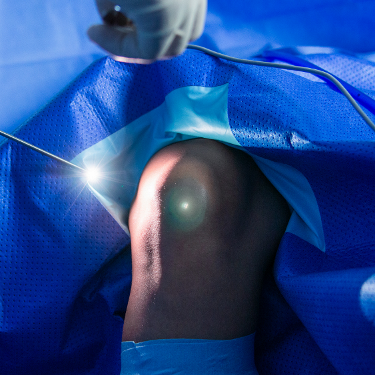
Arthroscopy (arthroscopy, or scope - viewfinder) is a minimally invasive method of surgery that allows you to penetrate the joint without having to open the body shell. The arthroscope is inserted through a hole with a diameter of approximately 8 mm. With its help, it is possible to detect and diagnose pathological changes in the knee joint and, most importantly, make a treatment procedure.
Arthroscopy is a fairly young method of diagnosis and treatment. Although similar operations were performed at the beginning of the 20th century, it was only the use of the so-called video track in the mid-1980s turned out to be a breakthrough. This increased the diagnostic possibilities and the effectiveness of the procedures performed. Thanks to further improvements, today arthroscopy is one of the most effective and popular methods of knee treatment.
It should be remembered that the word arthroscopy does not exactly describe the type of surgery, which may be, for example, arthroscopic reconstruction of the ACL ligament or arthroscopic suturing of the meniscus. This is only a methodology - joint endoscopy using very good quality magnifying optics and saline. The Dworska hospital uses an arthroscopic column with HD resolution and strong xenon light.
Appropriate treatment methods are selected depending on the damage to the joint.
Make an appointment now - with a knee arthroscopy specialist at our hospital
[title]
[image-intro]
[readmore text="Read more"]{/article}
[title]
[image-intro]
[readmore text="Read more"]{/article}
[title]
[image-intro]
[readmore text="Read more"]{/article}
Knee arthroscopy
Arthroscopy is a procedure in which using 2-4 holes - the so-called arthroscopic portals, you can perform a great variety of procedures inside the joint.
Simply put, these are the procedures performed on:
meniscus (removal of the meniscus, suturing of the meniscus - that is, repairing the meniscus, implanting artificial or human menisci from a tissue bank),
cartilage (currently there are several techniques for the reconstruction of cartilage or cartilage and bone defects),
ligaments inside the knee (ligament sewing or full reconstruction from a tendon or other ligament), e.g. an anterior cruciate ligament reconstruction is a frequently performed procedure.
Arthroscopically, pathologies of the patella can also be treated, including the most common: lateral support of the patella, instability of the patella and dislocation of the patella.
What are the indications for knee arthroscopy?
The main criterion of diseases that we treat arthroscopically is the presence of ailments in the patient resulting from pathologies inside the joint. A detailed description of these ailments, combined with a knee examination by a specialist and possibly additional tests - knee ultrasound or MRI of the knee, in most cases allows you to decide whether arthroscopy is indicated.
The most common symptoms that are ultimately treated arthroscopically include: pain, jumping in the joint, feeling unstable, knee escaping, and swelling (knee effusion).
Who can benefit from the treatment?
Knee arthroscopy is performed on patients 12 years of age and older. It is worth noting that in children under 16 years of age, due to the plasticity of the tissues and the enormous potential for regeneration, knee arthroscopy is rarely necessary. There is no upper age limit for arthroscopy, but there are several medical contraindications.
Contraindications for knee arthroscopy
Arthroscopy is not performed in the case of very advanced degeneration of the joint requiring arthroplasty. In this case, arthroscopy will not bring positive results.
Knee arthroscopy is also contraindicated if it is damaged, which may be self-healing or rehabilitation treatment.
The arthroscopy of the knee joint is avoided in the case of damage that can be healed by other methods - by intra-articular injections or biological and regenerative treatment.
In addition, arthroscopy is not performed during the treatment of other short-term diseases - e.g. infections of the throat and respiratory tract. This has to do with the medical procedures performed during the procedure.
Thorough examinations and qualification for the procedure are always carried out with the participation of an anaesthesiologist, whose task is to identify all possible pathologies before the surgery - for the benefit and safety of the patient.
How to prepare for arthroscopy?
The first preparations for the procedure are safest about 2 weeks before the scheduled date of arthroscopy. Then a set of basic tests should be performed, including: morphology, electrolyte and sugar levels, coagulation system, anti-HCV and HBS-antigen, and sometimes also an ECG and chest X-ray. These tests are usually performed within one day.
In urgent cases, it is possible to perform all tests on the spot on the day of consultation and, if the results are positive, perform the operation within the first day (e.g. after an injury).
The matter becomes a bit more complicated when the patient suffers from varicose veins. Then he should also consult a vascular surgeon who will give an opinion on any contraindications and check the patient's condition.
If someone is treated chronically, it is necessary to consult a specialist who will order any additional tests and finally issue a certificate of no contraindications for the treatment. Before the arthroscopy itself, a short visit to the anesthesiologist is also mandatory in order to exclude contraindications to the use of anesthesia.
There is no need to perform any other tests unless ordered by your doctor. You should be on an empty stomach just before the operation. The last light meal can be eaten about 6 hours before the procedure. Remember not to drink any fluids about five hours before the planned arthroscopy.
Course of knee arthroscopic surgery
Knee arthroscopy is one of the day surgical procedures. After coming to the hospital, the patient meets with an anesthesiologist who selects the appropriate method of anesthesia. In most cases, it is spinal anesthesia, i.e. an injection into the spine, which anesthetizes and temporarily incapacitates the lower limbs.
General anesthesia is used much less frequently, usually at the patient's special request or in circumstances that require it for medical reasons.
Most often, however, the patient is conscious during the procedure and can view the course of the procedure on the monitors installed in the operating room.
During the procedure, the orthopedist can show the patient the basic structures in the knee, which often makes it much easier to explain the purposefulness of the procedure and understand the essence of the disease, and affects the patient's caution in subsequent rehabilitation.
During the procedure, the patient is placed in the supine position. The surgeon makes two incisions of about 5 mm through which he introduces a very high-resolution camera and the necessary tools through the so-called working portal. If necessary, further incisions are made through which other arthroscopic tools are inserted.
Incisions are made in predetermined places. For this purpose, the operator uses the orientation in relation to the anatomical fixed points around the knee and knows about his operating plan - so that he can do everything from the best places for the portals, without making subsequent surgical accesses.
Thanks to multiple magnification, the surgeon can see the inside of the operated knee very accurately. The operator assesses the structures of the joint, e.g. the condition of the articular cartilage or menisci. If necessary, it can remove pathological synovial hypertrophy, which conflicts with the elements of the joint and causes knee pain. A procedure often performed in athletes and active people is arthroscopic reconstruction of the cruciate ligament or its repair using the Intenal Bracing method.
The duration of the operation is influenced by the type of joint damage and the method of treatment used. The length of the procedure is very variable - from 20 minutes for very simple and obvious procedures to 2.5 hours for complex multi-tissue reconstructions.
During arthroscopy of the knee joint at the Dworska Hospital, there is no need to coagulate the tissues (closing small vessels in the joint in order to prevent postoperative bleeding into the joint), which significantly reduces the risk of postoperative hematoma in the joint and accelerates the possibility of full limb movement and joint loading.
Doctors, during the preparation for the procedure, and in the operating room, explain exactly what actions they take. Thanks to this, the patient is aware that after the procedure he should follow certain recommendations and undergo professional rehabilitation. It should be remembered that it is as important as the procedure. In addition, in many cases the length and effectiveness of the treatment process depends on the patient's involvement.
How to proceed after arthroscopy?
Even after a perfectly performed procedure, most depends on the behavior of the patient himself and whether he or she complies with the recommendations of the doctor and physiotherapist. He must be aware that properly conducted rehabilitation is as important as the skills of the surgeon in the operating room.
Immediately after the procedure, the so-called Game Ready is used at the Dworska Hospital, i.e. a special device placed on the leg, which simultaneously compresses and effectively cools the operated knee. This distinguishes the Court Hospital among other medical institutions. It is a method that inhibits the formation of post-operative swelling and pain, and therefore significantly accelerates tissue regeneration and enables early rehabilitation.
Another added value is that there are physiotherapists on site in the hospital who teach to stand up and move around on crutches during the first 6-12 hours, if necessary, of course. They also demonstrate the basic principles of self-exercise, which is crucial for a proper healing process.
After discharge, the patient is advised to take thromboprophylaxis and take painkillers (if necessary).
It is also recommended to limit physical activity to the necessary minimum during this period. This is due to the possibility of increasing limb edema and postoperative hematoma.
The wounds are protected with dressings that should be protected from getting wet and changed every 3-4 days.
After some treatments, it is necessary to use the so-called knee stabilizer, also known as orthoses. The time of its use and the scope of permitted mobility are determined by the doctor on the day of discharge - it may vary from 2 to 6 weeks.
The operator also decides whether to load the operated limb - it is from 0 to 6 weeks.
Rehabilitation after knee arthroscopy
Immediately after the procedure, the first exercises should be conducted by a physiotherapist who works closely with the doctor supervising the treatment process. Usually, the patient should use elbow crutches for about 2-3 weeks after arthroscopy, although often after a few days the leg may be fully loaded.
A patient whose arthroscopy was limited to the removal of a free body, partial removal of the meniscus or synovial fold will reach full fitness much faster than a patient after repair or reconstructive procedures.
During rehabilitation, exercises are most often designed to strengthen muscles and joints. For this reason, it is usually recommended to carry out exercises such as supine and straightened limbs, contracting the calf muscles and strengthening the quadriceps immediately after surgery. After the rehabilitation process is properly carried out, it may take as little as 4-6 weeks to fully recover. However, it all depends on the level of complexity of the procedure performed.
Important information
| Duration of the procedure (depending on the method) | 30 -120 minutes |
| Basic tests required for the procedure | basic - preparation for surgery tab |
| Anesthesia | subarachnoid |
| Hospital stay | 3- 8 hours |
| The period of significant dysfunction | 5 - 21 days |
| The period of limited dysfunction | 3-10 weeks |
| Removal of stitches | 12 - 16 days |
| Change of dressings | every 3 - 4 days |
| Contraindications to the procedure | 4th degree arthritis, obesity |
Frequently asked questions about knee arthroscopy
In the case of knee arthroscopy, it cannot be clearly stated that it will return to full fitness after 7 or 10 days. How long the rehabilitation will take and when the patient will be able to return to work after arthroscopy largely depends on the type of arthroscopy performed and the patient's involvement in the rehabilitation process. Much faster recovery after arthroscopy, which involves the removal of a free body, partial removal of the meniscus or synovial fold, than after repair and reconstructive procedures. Usually, loading the joint is possible already 7 days after the procedure, and the crutches can be put aside after a period of 2-3 weeks. Recovery from arthroscopy usually takes about 3-12 weeks.
Knee arthroscopy is performed as part of a one-day surgery procedure. After coming to the hospital, the patient meets with an anesthesiologist who selects the appropriate method of anesthesia. Most often it is spinal anesthesia, i.e. an injection into the spine that anesthetizes the lower limbs. After local anesthesia, the doctor inserts the arthroscope through a hole approximately 5 mm in diameter. With its help, it is possible to detect, diagnose and "fix" pathological changes in the knee joint. The patient is conscious all the time during the procedure.
After the surgery, you need to undergo rehabilitation, during which the exercises are most often aimed at strengthening the muscles and joints. The physiotherapist, in consultation with the attending physician, selects the appropriate set of exercises so that the patient returns to full fitness as soon as possible.
A few days before the date of arthroscopy, a complete blood count should be performed, electrolyte and sugar levels, liver tests, and an EKG and chest X-ray should be taken. These tests can be done in one day. In the case of chronic diseases, consultation with a specialist is necessary. Before the arthroscopy itself, a short visit to the anesthesiologist should be made in order to exclude contraindications to the use of anesthesia.
You should take with you the current results of examinations and consultations as well as elbow crutches, basic documents - ID card.
Depending on the cause of the procedure, arthroscopy usually takes from half to two hours.
The type of anesthesia is consulted with the anesthesiologist. In most cases, knee arthroscopy is performed under subarachnoid anesthesia, which involves puncturing the spine, thanks to which the patient is conscious during the procedure, and his lower limbs are anesthetized and incapacitated. Very rarely, in exceptional cases, general anesthesia is used.
Rehabilitation after knee arthroscopy should be started as soon as possible. Consultation with a physiotherapist should take place several hours after the procedure. During the first days after the procedure, the patient should exercise under the strict supervision of a physiotherapist.
No, the procedure is performed under anesthesia. During recovery from arthroscopy of the knee, the patient may experience slight pain and discomfort.
Depending on the cause of the procedure, arthroscopy usually takes from 30 minutes to two hours.