De Quervain's syndrome, also known as "the sore thumb of the mother", manifests itself with superficial pain in the wrist at the base of the thumb. The cause of the ailments is irritation of the tendon sheaths surrounding the tendons of the thumb muscles. The formation of microdamages occurs as a result of disturbed sliding of the tendons during repeated grasping movements or manipulative movements involving the thumb. The popular term "mother's thumb" is associated with the frequent occurrence of the condition in mothers who grab and lift their babies multiple times a day. Currently, de Quervain's syndrome can also develop in people who write large amounts of text messages with their thumb.
Make an appointment now - with a doctor specializing in the treatment of de Quervain's syndrome at our hospital
[title]
[image-intro]
[readmore text="Read more"]{/article}
[title]
[image-intro]
[readmore text="Read more"]{/article}
[title]
[image-intro]
[readmore text="Read more"]{/article}
[title]
[image-intro]
[readmore text="Read more"]{/article}
For most people, it is sufficient to temporarily immobilize the wrist with an orthosis, rehabilitation and taking anti-inflammatory drugs. Strong symptoms are an indication for a steroid blockade. In rare cases, it is necessary to undergo surgery to decompress the tendons to facilitate their free sliding in the sheaths.
What is de Quervain's syndrome?
The essence of de Quervain's disease is mechanical irritation and inflammation of the tendon sheaths of the long abductor muscle of the thumb and the short extensor muscle of the thumb. The abdomens of these muscles lie within the distal epiphysis of the forearm bones, they pass into the tendons before the wrist and go towards the thumb. The end attachment of the long abductor muscle of the thumb is located on the base of the first metacarpal and trapezius bone, while the end attachment of the short extensor muscle is located on the base of the proximal phalanx of the thumb.
The place where there is frequent conflict of soft tissues is the first compartment of the extensor cord. Under the extensor cord, the tendons of the thumb extending and abducting muscles are surrounded by sheaths that facilitate sliding when making thumb movements. Disruption of tendon slippage in the sheaths may occur in the case of a thickening of the extensor retinaculum, as well as in conditions of disproportion in the circumference of the tendons under the strap and in the proximal and distal sections of the retina [1]. Movements of the affected tendon in a channel that is too narrow lead to irritation and inflammation of the tendon sheath. The risk of de Quervain's syndrome is also higher:
- in people suffering from systemic inflammatory diseases - in the course of rheumatoid arthritis, the formation of post-inflammatory adhesions of soft tissues surrounding the tendons of the thumb muscles,
- in post-traumatic and degenerative conditions of the wrist - abnormal bone changes can independently lead to mechanical irritation of the tendon sheaths of the wrist and thumb.
Symptoms of de Quervain's syndrome
A typical symptom of de Quervain's disease is pain in the thumb and lateral side of the wrist above the first dorsal extensor compartment. Pain in the thumb and wrist increase when grasping and manipulating the hand, and soften during rest. There may be slight swelling and tenderness of the dorsal part of the thumb. The occurrence of the above symptoms should prompt you to visit an orthopedist who will assess the condition of the tendon sheaths, exclude the presence of other pathologies and propose appropriate treatment.
The diagnosis of de Quervain's disease
During the visit, the orthopedic surgeon conducts a detailed interview, during which he obtains information about the nature of the ailments, the type of activity and work undertaken by the patient, and comorbidities that could contribute to the development of de Quervain's disease. Then it performs the so-called Finkelstein test, a positive result of which may indicate a pathology within the tendons of the thumb muscles. The test consists in placing the thumb in a fist-clenched hand and tilting the wrist elbow so that the soft tissues of the dorsal side of the thumb are stretched. A positive result means pain in the area of the styloid process of the radius and above the tendons in the extension and thumb abduction muscles. You should always compare your feelings with the other side. 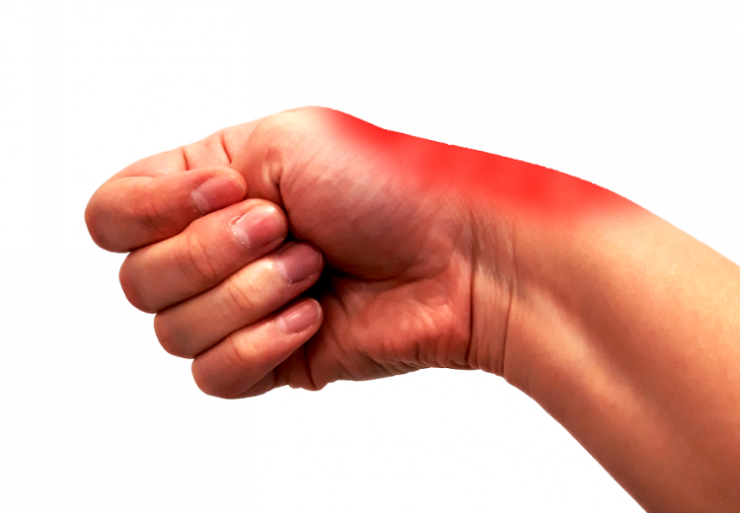
The initial diagnosis is confirmed by ultrasound of the hand, which shows the swelling of the tendon sheaths and fibrotic changes of the extensor retinaculum. Moreover, dynamic ultrasound examines the sliding of the tendons of the thumb muscles in relation to the extensor retinaculum.
De Quervain's disease should be differentiated from other pathologies that give similar symptoms:
1. Inflammation of the carpometacarpal joint of the thumb (CMC, articulatio carpometacarpalis)
Both CMC arthritis of the thumb and Quervain's disease are positive for the Finkelstein test. In order to differentiate between the two conditions, axial pressure is applied along the first metacarpal bone - pain and crackles indicate inflammation of the CMC joint of the thumb.
2. Fracture of the scaphoid bone
In the case of a scaphoid bone fracture, additional tenderness is observed in the area of the anatomical snuffbox (in the triangular cavity between the tendon of the long extensor muscle of the thumb and the tendons of the short extensor and long abductor muscles). The fracture is confirmed on X-rays.
3. Chauffeur break
The chauffeur's fracture concerns the styloid process of the radial bone - there is local pain in the styloid process. The fracture is confirmed on X-rays.
4. Wrist intersection syndrome
The disease is caused by overloading of the tendons of the muscles of the first and second extensor compartments of the wrist at the point of their intersection. In the case of the intersection syndrome, pain is observed on the back of the wrist with flexion and extension movements (wrist pain does not occur in the elbow deviation).
Treatment of de Quervain's syndrome
Conservative treatment
The choice of treatment methods depends on the severity of symptoms, the duration of the symptoms and the attempts to treat the disease that have been undertaken so far.
In most cases, it is necessary to temporarily immobilize the wrist and thumb joints to limit the mechanical irritation of the tendon sheaths. A special wrist and thumb orthosis is used for this purpose and should be worn for 3-8 weeks. The interphalangeal joint does not need to be immobilized because the movements that occur in it do not directly affect the sliding of the tendons involved in de Quervain's syndrome. During the day, the orthosis is removed only for the duration of rehabilitation, i.e. for wrist and thumb exercises performed in the painless range of motion. This is to prevent the muscle tendons from forming undesirable adhesions. In addition, local phonophoresis treatments using 10% hydrocortisone can be used. To maintain the mobility of the soft tissues of the hand, it is advisable to undergo special techniques in the field of myofascial therapy.
For the first two weeks, it is recommended that you take non-steroidal anti-inflammatory drugs (NSAIDs) to help reduce the swelling and pain in the thumb. More severe complaints may require a steroid block to the affected tendon sheath. It should be noted that discomfort may still be present for 2 days after injection, as the proper analgesic effect of the corticosteroid begins approximately 48 hours after its administration. The therapeutic effect of steroid blockade in de Quervain's syndrome is the subject of much debate. It is proposed that in addition to their potent anti-inflammatory effect, corticosteroids may also have a relaxing effect on the tense structures of the extensor cord, which leads to an increase in the space in which the tendons run. However, this hypothesis requires confirmation. Due to the possibility of local foci of soft tissue (including skin) necrosis, it is not recommended to perform more than 1-3 injections of the steroid in the same place.
As the pain subsides, the wearing of the orthosis is gradually withdrawn. However, the patient should modify his professional or sports activity so as not to re-overload the tissues. The physiotherapist gives instructions regarding hand movements that are not recommended and can secure the thumb with taping, i.e. special tapes glued to the skin.
Surgery
The goal of surgical treatment of de Quervain's syndrome is to decompress the trapped tendons by incising the tendon sheath, resection of necrotic tissues and removal of post-inflammatory adhesions. The drawstring of the first extensor compartment is also cut to increase the space for the tendons. Surgical treatment is reserved for patients who, despite several months of conservative treatment attempts, are not satisfied with the results due to persistent pain in the thumb.
The surgical procedure is performed under anesthesia consisting in blocking the nerves gazing at the upper limb. The patient remains conscious throughout the procedure. Open surgical access is preferable because it allows for an accurate assessment of the condition of tissues and precise removal of pathological changes. The surgeon makes a 2-3 cm incision at the base of the thumb. After the surgery, it is necessary to participate in the rehabilitation process, the aim of which is to make the scar more flexible, to maintain the conditions for a conflict-free sliding of the tendons and to restore the grasping and manipulation functions of the hand.
Sources:
1. Huisstede BM, Coert JH, Fridén J, Hoogvliet P; European HANDGUIDE Group. Consensus on a multidisciplinary treatment guideline for de Quervain disease: results from the European HANDGUIDE study. Phys Ther. 2014 Aug;94(8):1095-110.
2. Brotzman S, Calandruccio J, Jupiter J. Uszkodzenia ręki i nadgarstka [w:] Brotzman S, Wilk K. Rehabilitacja ortopedyczna, tom 1, Elsevier Urban&Partner, Wrocław 2008, s. 102-105.
Frequently asked questions about de Quervain's syndrome:
The essence of de Quervain's disease is mechanical irritation and inflammation of the tendon sheaths of the thumb extending and abducting muscles. The symptom of the disease is pain on the dorsal part of the thumb and the wrist area under the thumb, which increases with grasping and manipulative movements of the hand, and softens when resting. There may be slight swelling and tenderness of the dorsal part of the thumb. The occurrence of the above symptoms should prompt you to visit an orthopedist who will assess the condition of the tendon sheaths, exclude the presence of other pathologies and propose appropriate treatment.
Conservative treatment of de Quervain's disease consists of:
- wearing an orthosis that stabilizes the wrist and the metacarpophalangeal joint of the thumb,
- avoiding movements that exacerbate pain in the thumb and wrist,
- myofascial therapy,
- treatments in the field of physical therapy,
- the use of anti-inflammatory drugs.
In case of severe ailments, a blockade is performed, i.e. a corticosteroid is administered to the inflamed tendon sheath. If the conservative treatment is unsuccessful, a surgical procedure is performed to remove adhesions that prevent the free sliding of the thumb tendons. After the surgery, it is necessary to participate in rehabilitation, which includes scar mobilization, restoration of full thumb mobility and gradual strengthening of the grip strength.
De Quervain's disease is a term used to refer to two different conditions - thumb muscle tenosynovitis and thyroiditis.