Sports pubalgia manifests as pain in the groin or the symphysis pubis caused by injury to the abdominal muscles and / or the adductor muscles of the thigh. Injuries most often occur when practicing sports with a large component of changes in the direction of the run, which is why the term "sports" is used. The second name commonly accepted in the media or on the Internet is "sports hernia", although it should be noted that muscle tear does not always lead to a classic hernia, in the course of which internal organs bulge. The diagnosis of sports pubalgia is not easy due to the multitude of pathologies that give symptoms in the groin area. Proper diagnosis enables the implementation of appropriate treatment, which in most cases includes rehabilitation.
Make an appointment now - with a physician specializing in sports treatment at our hospital
[title]
[image-intro]
[readmore text="Read more"]{/article}
How does an injury happen?
Sports pubalgia occurs in athletes practicing disciplines that are characterized by sudden changes in the direction of running and positions in wide legs combined with torsional movements of the torso (footballers, hockey players, rugby players, tennis players). The pelvis in the area of the pubic symphysis is then subjected to enormous forces related to the tension of the abdominal muscles and the muscles of the thigh adductors. These forces are transferred by the so-called pubic aponeurosis complex, which is made up of:
- rectus abdominal muscle fascia (the force acts from the top),
- aponeurosis of the oblique muscles and the transverse muscle (force acts obliquely from the top),
- the tendons of the adductor muscles of the thigh (force acts obliquely from below) and the slender muscle (from below).
The anterior wall of the lower abdomen (under the arched line) is formed by a group of muscles, fasciae and aponeurosis. The rectus abdominis muscle, starting at the lower costal arches and the sternum, runs vertically downward and attaches to the pubic symphysis and pelvic crest. In front and behind, the rectus abdominis muscle is surrounded by a sheath formed from the front by the tendons of the external oblique, internal oblique and transverse muscles. At the back, the rectus abdominis muscle is only separated from the peritoneum by a thin transverse fascia. The transverse fascia has an opening (the so-called deep ring) for the inguinal canal. The inguinal canal is the structure in which the seminal ducts run in men and the round ligament in women. The transverse fascia, especially in the area of the deep ring, is a site of reduced strength in the abdominal wall, therefore damage is often caused in this place.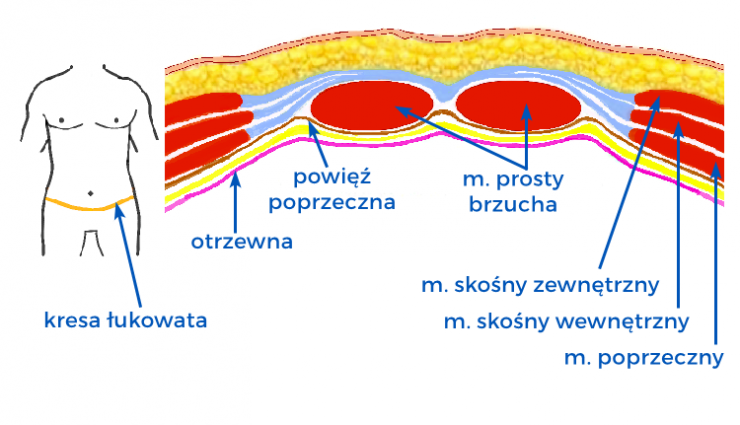
What structures are damaged?
Pain in the groin or the symphysis pubalgia may result from:
- Tendinopathy or torn tendons of the thigh adductors on the pubic bone,
- Tears at the attachment of the abdominal prote muscle on the pubic bone,
- Secondary symphysis pubis,
- Damage to the posterior ring of the inguinal canal (damage to the transverse fascia of the abdomen).
The most common injuries are the attachment of the rectus abdominis muscle and the attachment of the adductor muscles on the pubic bone
Sports hernia diagnosis
There are five typical symptoms that indicate a sports injury [2]:
Subjective pain in the groin or lower abdomen,
Pain increases with exertion (e.g. during sprints or sit-up crunches) and decreases with rest,
Current palpation of the pubic branch at the attachment of the rectus abdominis muscle and adjacent tendons,
Pain when trying to resist 90-degree bend and / or bringing the thigh to a 45-degree angle,
Pain when trying to resist abdominal curl-up from lying down.
Imaging tests are a valuable help in confirming the initial diagnosis from a clinical trial. Magnetic Resonance Imaging (MRI) allows the visualization of bone marrow edema of the pubic bone and changes indicating muscle damage at bone attachments or damage to the transverse fascia. Due to the greater availability, a dynamic ultrasound examination is also performed, during which swelling of damaged soft tissues and torn muscle tendons can be detected.
Sports pubalgia should be distinguished from other pathologies or conditions that may be manifested by pain in the groin:
- acetabular-femoral conflict (FAI, femoro-acetabular impingement),
- osteoarthritis of the hip joint,
- aseptic necrosis of the femoral head,
- crackling hip
- tear of the rectus muscle attachment of the thigh from the anterior iliac spine of the pelvis,
- pains transferred from the organs of the lower abdomen (inflammation of the urinary tract, endometriosis, ulcerative colitis).
Sports pubalgia - treatment
Conservative treatment
Minor damage can be treated conservatively through rehabilitation under the supervision of an experienced physiotherapist. The awareness of the injury mechanism and proper instruction in activating and strengthening the appropriate muscle groups are necessary for the athlete to return to sports within 6-8 weeks from the start of therapy.
In the early phase of treating pubalgia, it is advisable to give up strenuous training. Each patient should be carefully assessed for mobility limitations in the hip and lumbar spine, lower limb linearity abnormalities, muscle tension imbalances, and negative compensations when performing simple functional tests.
Rehabilitation should include myofascial therapy aimed at balancing abnormal tensions within the spine-pelvis-lower limb complex. If necessary, mobilization of the hip, sacroiliac joints and spine is performed.
Then the physiotherapist teaches you how to activate the muscles responsible for stabilizing the torso, i.e. multisection and transverse abdominal muscle. The goal of therapy is to restore the correct "timing" of the muscles to work - first the deep muscles, then the more superficial muscles. It allows to reduce the compensatory hyperactivity of the abdominal protic muscle in the absence of active stabilization of the deep muscles. An important task is also to strengthen the muscles responsible for stabilizing the hip joint.
After achieving the balance of tensions within the pelvis and the ability to properly stabilize the torso, training of individual phases of gait is introduced. The gait should be symmetrical and have proper pelvic movement patterns. The last stage of rehabilitation is the training of movement patterns specific to a given sports discipline and strength and endurance exercises.
Surgery
Patients whose conservative treatment has not brought the expected results or diagnosed with an accompanying inguinal hernia are referred for surgery. The surgical procedure can be performed openly or by the endoscopic method. Sometimes it is necessary to strengthen the site of damage with an extraperitoneal mesh implanted behind a branch of the pubic bone or into the back wall of the inguinal canal. The choice of the method of surgery rests with the attending physician.
Sources:
- Elattar O, Choi H-R, Dills VD, Busconi B. Groin Injuries (Athletic Pubalgia) and Return to Play. Sports Health. 2016;8(4):313-323.
- Ellsworth, Abigail A., Mark P. Zoland, and Timothy F. Tyler. Athletic pubalgia and associated rehabilitation. International Journal of Sports Physical Therapy 2014;9(6): 774–784.
Frequently asked questions about sports pubalgia:
Sports pubalgia manifests itself as pain in the groin or the symphysis pubis caused by torn tendons in the abdominal muscles and / or those of the thigh adductors. These muscles attach to the pubic bone. Sports pubalgia occurs in athletes practicing disciplines that are characterized by sudden changes in the direction of running and positions in wide legs combined with torsional movements of the torso (footballers, hockey players, rugby players, tennis players). The pelvis in the area of the symphysis is then subjected to enormous forces related to the tension of the abdominal muscles and the thigh adductors, which leads to an injury. Sports pubalgia also includes damage to the transverse fascia of the abdomen, which can sometimes lead to an inguinal hernia.
Treatment of torn prote muscle attachment to the pubic bone involves properly directed rehabilitation. In the first stage, the aim is to heal the damaged tendon of the muscle. The next goal is to equalize abnormal tensions within the spine-pelvis-lower limb complex and learn to activate the muscles responsible for the active stabilization of the trunk. The last stage includes strengthening exercises and strength and endurance training in patterns typical for a given sports discipline. In most cases, it is possible to return to sports in the 6-8 weeks after starting physiotherapy.
Inguinal hernia may occur only in some cases of damage to the abdominal integuments typical of sports pubalgia. Extensive tearing of the abdominal transverse fascia may be related to the actual bulging of the lower abdominal organs by the damaged area. In most cases, however, pubalgia involves injuries to the attachments of the abdominal muscles and the muscles that add to the thigh to the pubic bone, which is not accompanied by the formation of a hernia.