CONTACT: contact@dworska.pl | +48 12 352 25 25

Gojenie ran jest procesem wykształconym w ciągu milionów lat rozwoju filogenetycznego człowieka. Podczas gojenia ran zachodzą złożone zjawiska chemiczne i fizyczne biologicznie aktywnych substancji, doprowadzające do wytworzenia blizny. U człowieka rany goją się przez reparację czyli naprawę. Proces ten należy odróżnić od regeneracji bez wytworzenia blizny, który występuje w okresie płodowym. Jedynym narządem, który ma zdolność regeneracji poza okresem płodowym jest wątroba.

W procesie gojenia rany wyróżniamy trzy zasadnicze fazy:

1. oczyszczanie rany, 2. proliferacja, 3. obkurczanie rany i wytworzenie blizny.

Umów wizytę teraz do lekarza specjalizującego się w leczeniu blizn

{article 538}

[title]


[image-intro]
[readmore text="Wybierz specjalistę"]{/article}
 

Faza oczyszczania rany

W obrazie makroskopowym uraz tkanek powoduje przerwanie ciągłości naczyń krwionośnych i wynaczynienie krwi. Natychmiastowa odpowiedź uszkodzonych tkanek polega na powstaniu skrzepu i miejscowego skurczu naczyń krwionośnych. Faza ta manifestuje się typowymi objawami stanu zapalnego: ociepleniem, obrzękiem, zaczerwienieniem oraz bólem. W obrazie mikroskopowym w początkowym etapie gojenia rany podstawowa rolę odgrywają płytki krwi. Wchodzą one w kontakt z wewnątrznaczyniowym kolagenem i tkankowymi czynnikami o charakterze prokoagulacyjnym, uwalnianymi z uszkodzonych tkanek. To powoduje adhezję płytek krwi do uszkodzonych tkanek oraz inicjuje kaskadę ich aktywacji i agregacji. Pobudzone płytki krwi uwalniają z ziarnistości alfa zmagazynowane w nich substancje indukujące krzepnięcie. Ułatwiają one formowanie czopu hemostatycznego zapewniającego hemostazę i tworzącego tymczasową macierz zewnątrzkomórkową. Płytki krwi wydzielają również czynniki, takie jak PDGF, TGF-α, TGF-β, będące chemoatraktantami dla komórek mięśniowych gładkich i fibroblastów. PDGF odgrywa kluczową rolę we wszystkich stadiach prawidłowego gojenia ran, będąc silnym aktywatorem komórek mezenchymalnych, stymulując chemotaksję i proliferację monocytów, makrofagów i fibroblastów oraz wpływa na ekspresję nowych genów w wyżej wymienionych komórkach. Stan zapalny rozpoczyna się, gdy do rany napływają leukocyty pod wpływem chemoatraktantów, do których należą fibrynopeptydy, PAF, leukotrien B4, PF-4, PDGF. Jako pierwsze napływaja neutrofile, które poprzez uwalnianie elastazy i kolagenazy mogą penetrują w głąb czopu, ułatwiając także wnikanie do niego drobnych naczyń krwionośnych. Neutrofile oczyszczają ranę z bakterii i martwych oraz uszkodzonych komórek i fragmentów tkanek poprzez endocytozę (mają właściwości fagocytarne) oraz uwalnianie enzymów lizosomalnych. W kolejnym etapie rozpoczyna sie napływ monocytów przy zmniejszającej się infiltracji neutrofili.

Faza proliferacji

W fazie tej nowy zrąb zaczyna naciekać obszar rany. Tworzące się liczne, nowe kapilary przyczyniają się do specyficznego, ziarnistego wyglądu owrzodzenia. W obrazie mikroskopowym rozróżniamy następujące po sobie etapy – tworzenia ziarniny, epitelializacji oraz neowaskularyzacji.

Przyleganie monocytów do białek macierzy zewnątrzkomórkowej indukuje wydzielanie między innymi czynnika stymulującego kolonie – CSF-1, który pobudza makrofagi do wydzielania cytokin i proteaz – TNF-α, PDGF, TGF-α, TGF-β, IL-1, IGF-1, zwiększając ich zdolność do walki z czynnikami zakaźnymi. W ranie monocyty ulegają przemianie fenotypowej w makrofagi, które kontynuują niszczenie drobnoustrojów i oczyszczanie rany wspomagane przez sekrecję cytokin: TNF-α, IL-1,

HLA-DR. Makrofagi, poza oczyszczaniem owrzodzenia, uwalniają cytokiny (PDGF, FGF, TGF-β) przyciągające fibroblasty z otoczenia rany i stymulujące ich proliferację. W tym etapie gojenia rany biorą udział także inne komórki zapalne, takie jak limfocyty, komórki plazmatyczne, mastocyty. Wspomagają one gojenie między innymi przez produkcję IL-4 oraz stymulują fibroblasty do produkcji kolagenu. Szczególnie istotnym dla gojenia rany jest, aby reepitelializacja przebiegała szybko; z jednej strony chroni ona wnętrze rany przed szkodliwymi czynnikami zewnętrznymi (zakażeniem, zanieczyszczeniem, promieniowaniem), z drugiej strony minimalizuje utratę wody i elekrolitów przez ranę. Powstałe keratynocyty zaczynają przemieszczać się w kierunku rany dzięki ekspresji receptorów integrynowych na ich powierzchni, pozwalających na interakcje z białkami macierzy zewnątrzkomórkowej. Proces ten odbywa się skokowo (żabimi skokami) co 12-18 godzin i prowadzi, przy niezaburzonym gojeniu, do tworzenia nowych komórek nabłonka z szybkością około 2mm tkanki na dobę. Dopiero po całkowitym pokryciu rany pojedynczą warstwą nabłonka, keratynocyty proliferują, a następnie różnicują się w poszczególne elementy naskórka. Tempo rozrostu, intensywne w początkowym etapie epitelializacji, zmniejsza się w miarę zbliżania komórek z przeciwległych brzegów rany i rozciąga na kolejny etap gojenia, czyli neowaskularyzację. Nowo tworzące się naczynia krwionośne dostarczają tlen oraz składniki odżywcze niezbędne do intensywnego metabolizmu komórek biorących udział w gojeniu rany. Proces ten wydaje się bardzo złożony i w dalszym ciągu nie został do końca poznany. Jego indukcję przypisuje się czynnikowi śródbłonka naczyniowego – VEGF, TGF-β, angiogeninie, angiotropinie 1 oraz trombospondynie.

Faza obkurczania rany oraz wytworzenia blizny

W fazie tej następuje przekształcenie żywoczerwonej ziarniny w bladą tkankę zawierającą dużą liczbę włókien kolagenowych. Rana ulega obkurczeniu, jej powierzchnia się zmniejsza, w całości zostaje pokryta cienką warstwą nabłonka. Po zakończeniu przebudowy prawidłowo zagojona rana traci cechy blizny przerostowej, ulega zmniejszeniu, ścieńczeniu i zblednięciu. Fibroblasty stymulowane przez cytokiny uwalniane z makrofagów naciekają obszar rany, uwalniając własne proteazy, umożliwiające im migrację w skrzeplinie. Produkują też duże ilości fibronektyny (FN), kwasu hialuronowego (HA) oraz kolagenu typu I i III o decydującym znaczeniu dla dalszego gojenia. Te składniki formują nową macierz w miejscu degradowanej macierzy fibrynowej oraz rekrutują i stymulują kolejne fibroblasty na drodze auto- i parakrynnej. W chwili gdy obficie wyprodukowana macierz kolagenowa zostanie zdeponowana, fibroblasty przestają produkować kolagen a ziarnina jest zastępowana przez ubogokomórkową tkankę włóknistą. Nowo powstałe włókna, dotąd ułożone chaotycznie, ulegają organizacji w bardziej regularną strukturę. Włókna kolagenu typu III przekształcane są w kolagen typu I aż do chwili uzyskania równowagi charakterystycznej dla zdrowej skóry (I:III – 4:1). Fibroblasty ustawiają się w promieniowej osi owrzodzenia i łączą się ze sobą oraz z podłożem poprzez integryny i ciasne złącza. Włókna aktynowe tworzą się wzdłuż długiej osi fibroblastów. W kolejnym etapie fibroblasty przekształcają się w miofibroblasty mające zdolność kurczenia się, zmniejszając obszar rany, po czym na drodze programowanej śmierci komórek pozostałe w ranie miofibroblasty i makrofagi są usuwane. Nowy naskórek pozbawiony jest mieszków włosowych, gruczołów oraz melanocytów. Zapewnia jednak odporność rany na rozciąganie i rozerwanie, a wytrzymałość ta ulega zwiększeniu podczas zachodzących w fazie bliznowacenia procesów modelowania i naprawy. Nigdy jednak nie osiąga wytrzymałości zdrowej skóry, osiągając 70% wytrzymałości po 6-12 miesiącach od urazu.

Celem leczenia rany jest jej zagojenie (ranę uznaje sie za zagojoną, jeśli jej powierzchnia pokryta jest nabłonkiem), uzyskanie dobrej funkcji (brak przykurczów bliznowatych) oraz uzyskanie dobrego wyniku estetycznego (blizna mało widoczna). Możliwość uzyskania powyższych trzech celów zależy od wielu czynników klinicznych.

Wiek pacjenta. U ludzi starszych rany goją się z mniejszym odczynem łącznotkankowym – rzadziej powstają blizny przerostowe, nasilenie procesów regeneracyjnych słabnie wraz z wiekiem.

Lokalizacja pierwotnej zmiany. Blizny przerostowe powstają w okolicy mostka, w okolicy naramiennej, na karku, w okolicach krzyżowania się kres zgięciowych po stronie zginaczy na kończynach. Blizny przerostowe nie powstają prawie nigdy na powiekach i na zewnętrznych narządach płciowych.

Kierunek przebiegu rany w stosunku do linii zmniejszonego napięcia skóry (Langera). Blizny linijne położone wzdłuż tych linii są wąskie i w mniejszym stopniu ulegają poszerzeniu niż blizny przebiegające prostopadle do linii Langera.

Sposób gojenia się rany. W trakcie gojenia przez rychłozrost (per primam), w przeciwieństwie do gojenia przez ziarninowanie (per secundam), wszystkie procesy gojenia są znacznie mniej nasilone, trwają krócej, a powstająca blizna charakteryzuje się dobrą funkcją i estetyczną formą.

Powikłania w gojeniu się rany. W wyniku powikłań (zakażenie, krwiak, rozejście się rany) często dochodzi do powstania blizn przerostowych.

Ogólny stan pacjenta. Istotne znaczenie w procesie gojenia ma odżywienie (ocena poziomu albumin), niedotlenienie, sterydoterapia, cukrzyca, stan po napromienianiu.

Genetyczne uwarunkowania. Istnieje skłonność do tworzenia bliznowców u rasy czarnej i osobników albinotycznych.

Kształt rany. Blizny w kształcie koła mają dużą tendencję do koncentrycznego obkurczania się. W bliznach półkolistych tkanki objęte półkolem zostają uniesione ponad poziom okolicznych tkanek.

Czas jaki upłynął od zranienia. Proces gojenia, a więc wytworzenia blizny jest długotrwały i składa się na niego również okres przebudowy blizny. Ostateczną formę i funkcję blizny można ocenić dopiero po 6 a nawet po 12 miesiącach.

W procesie gojenia się rany w zależności od powyższych czynników powstają następujące typy blizn: blizna linijna, blizna przerostowa, przykurcz bliznowaty, blizna zanikowa, bliznowiec (keloid).

Istnieje istotna różnica między tym, czy planuje się cięcie skóry w celu wykonania planowego zabiegu chirurgicznego, czy też zranienie skóry powstaje w następstwie wypadku i ma zostać zaopatrzone zgodnie z zasadami chirurgii plastycznej. Celem leczenia w obu przypadkach jest uzyskanie płaskiej, wąskiej i możliwie mało widocznej blizny. W celu uzyskania takiej blizny cięcie skórne musi przebiegać zgodnie z przebiegiem linii Langera. Szczególne znaczenie dla planowania cięć mają linie skórne powstające na twarzy w następstwie ruchów mimicznych. Zaplanowane cięcia skóry można również umieścić w liniach, które oddzialają od siebie określone części ciała. Dodatkowym sposobem, w wyniku którego blizny i cięcia skórne można kształtować w sposób możliwie taki, aby nie zwracały uwagi, jest wykonanie tych cięć na obszarach owłosionych lub na granicy okolic owłosionych. Cięcia skórne należy prowadzić równo i prostopadle do powierzchni skóry. Zmiany skórne można wyciąć, stosując zwykłe cięcie owalne lub w kształcie rombu. Wybór sposobu wycięcia zależy od tego, czy ranę będzie można zamknąć przez zwykłą adaptację jej brzegów czy zamknięcia rany będzie można dokonać za pomocą przesunięcia płata lub przeszczepu skóry. Należy zwrócić szczególną uwagę na dokładną hemostazę, zapobiegając tym samym powstaniu krwiaka czy zropienia rany. Przy ranach urazowych należy pamiętać, aby oszczędnym wycięciem wytworzyć gładkie brzegi rany. Cały obszar zakażonych przez bakterie i martwych tkanek należy wyciąć. Zamknięcie rany w dwóch warstwach zapobiega tworzeniu się jam w tkance podskórnej i przez to również powstawaniu zbiorników z treścią surowiczą.

Bardzo istotne znaczenie ma unikanie napięcia brzegów rany, czemu możemy zapobiec stosując szwy podskórne (przy głębszych ranach) czy podminowanie brzegów skóry. Rany obejmujące tylko skórę, bez tkanki podskórnej, zaopatruje się szwami jednowarstwowymi (pojedynczy szew węzełkowy, ciągły szew śródskórny). Rany głębsze wymagają zastosowania także szwów podskórnych (wchłanialnych) a na skórę możemy zastosować szwy adaptacyjne czy materacowe. Blizna będzie tym delikatniejsza i mniej widoczna, im mniej zużyje się materiału do szycia. Dlatego też zaleca się jak najwcześniejsze i całkowite usunięcie materiałów użytych do szycia. Należy pamiętać, szczególnie przy ranach na twarzy, że szwy podskórne założone tuż pod skórą, w trakcie wchłaniania mogą opóźniać proces gojenia. Przy zaopatrywaniu każdego rodzaju rany powinniśmy stosować delikatne narzędzia, odpowiednio dobrane szwy oraz stosować atraumatyczną technikę.

Blizna przerostowa może stanowić problem tylko estetyczny, niestety może również być przyczyną przykurczu bliznowatego, a więc dodatkowo stanowić problem czynnościowy. Blizny przerostowe powstają w wyniku gojenia się ran z ubytkiem tkanek bez pokrywania ich przeszczepami skóry. Gojenie następuje w procesie ziarninowania. Powstała blizna ma nierówną powierzchnię, jest twarda i zaczerwieniona. Po kilku, kilkunastu miesiącach w wyniku procesu inwolucji blizna taka samoistnie zmięknie, wyrówna swoją powierzchnię i stanie sie podobna do otaczających tkanek. Możemy przyspieszyć proces inwolucji blizny przerostowej stosując kompresoterapię, masaż z maścią silikonową, natłuszczanie blizny, ostrzykiwanie kortykosteroidami (1 raz w miesiącu).

Przykurcz bliznowaty jest to przemieszczenie tkanek przez bliznę do nieprawidłowej pozycji lub utrwalenie w nienaturalnej pozycji ruchomych części ciała. Blizna powodująca powstanie przykurczu bliznowatego może mieć charakter blizny płaszczyznowej lub pasma bliznowatego. Ciężkość przykurczu zależy od dwóch czynników: głębokości zmian bliznowatych oraz ich rozległości. Głębokie zmiany bliznowate są wynikiem rozległego ubytku tkanek w miejscu pierwotnego urazu. Najlepsze wyniki leczenia uzyskuje się w sytuacji, kiedy blizna obejmuje tylko skórę, ewentualnie tkankę podskórną. Jeżeli blizna sięga do warstwy mięśniowej a nawet stawów, leczenie w takich przypadkach jest znacznie trudniejsze a wyniki leczenia gorsze. Zabieg operacyjny z powodu przykurczu bliznowatego wykonuje się w okresie inwolucyjnym blizny, zwykle po około 1 roku od urazu. Wyjątkiem są przykurcze z dużym upośledzeniem funkcji, np. wywinięcie powieki z odsłonięciem rogówki czy wywinięcie wargi z wyciekiem śliny z jamy ustnej. Zabieg operacyjny przykurczu bliznowatego polega na przecięciu, a lepiej na wycięciu blizny, odprowadzeniu tkanek do ich naturalnego położenia, nawet z hiperkorekcją i na pokryciu ubytku wolnym przeszczepem skóry lub płatem. Małe ubytki skóry pokrywa się przeszczepem skóry pełnej grubości (przeszczep skóry pełnej grubości ulega najmniejszemu obkurczeniu). Duże ubytki, ze względu na niedobór miejsc dawczych przeszczepów skóry pełnej grubości, pokrywa się grubymi przeszczepami skóry pośredniej grubości. Jeżeli przykurcz bliznowaty jest spowodowany przez głęboką bliznę, po wycięciu której w dnie znajdują się nerwy, duże naczynia, kość zbita obnażona z okostnej, chrząstka obnażona z ochrzęstnej, ścięgno pozbawione ościęgna lub torebka stawowa to po wycięciu tej blizny ubytek musi być pokryty wcześniej zaplanowanym płatem z najbliższej lub z odległej okolicy ciała. Mogą to być płaty uszypułowane lub wolne, skórno-tłuszczowe, skórno-powięziowe, skórno-mięśniowe, mięśniowe z przeszczepem skóry. Przykurcze bliznowate spowodowane bliznami pasmowatymi można odprowadzać z zastosowaniem plastyki miejscowej z użyciem tkanek blizny – wielokrotna Z-plastyka. Po zakończonym zabiegu operacyjnego należy unieruchomić ruchome, a wcześniej przykurczone części ciała w pozycji maksymalnego odprowadzenia przykurczu. Unieruchomienie należy utrzymać przez okres 1 miesiąca, a następnie należy zastosować usprawnianie i dodatkowo unieruchomienie na noc przez kilka miesięcy (okres przebudowy blizny).

Keloid (bliznowiec). Definicję keloidu podał Peacock w 1970 roku; musi on spełniać trzy warunki – 1. swoim zasięgiem przekracza granice pierwotnej rany, 2. nie podlega procesowi inwolucji, 3. prawie zawsze nawraca po prostym wycięciu i zeszyciu.

Inne kryteria keloidu to :

  1. Czas powstawania – keloid powstaje późno po zabiegu, po około 3 miesiącach, a czasem nawet po kilku latach (blizna przerostowa powstaje po 3-4 tygodniach po zabiegu i ulega inwolucji po 3-6 miesiącach),
  2. Dolegliwości w postaci samoistnego swędzenia, pieczenia, a nawet bólu oraz w postaci przeczulicy na drobne bodźce są bardziej nasilone niż w bliznach przerostowych,
  3. Keloidy lokalizują się zwykle w szczególnych okolicach ciała – mostek, okolica naramienna, kark, płatek małżowiny usznej (blizny przerostowe lokalizują się zwykle po stronie zginaczy na kończynach i mają tendencję do tworzenia przykurczów bliznowatych),
  4. Przyczyna powstawania keloidów jest nieznana, można doszukać się skłonności rodzinnej (blizny przerostowe powstają często w wyniku powikłań w gojeniu się ran lub w wyniku zwiększonych napięć w ranie – krzyżowanie kres zgięciowych na kończynach)
  5. Keloidy i blizny przerostowe częściej występują u ludzi ciemnoskórych, z grupą krwi A, alergików,
  6. Keloidy i blizny przerostowe powstają w wyniku zaburzenia równowagi pomiędzy produkcją i degradacją kolagenu; te zaburzenia równowagi na rzecz produkcji kolagenu sa znacznie bardziej nasilone w keloidach. Zanim rozpocznie się leczenie należy postawić rozpoznanie.    

Rozpoznanie „keloid“ lub „blizna przerostowa“ można postawić tylko na podstawie obserwacji. Należy pamiętać, że skóra może być miejscem rozwoju nowotworów złośliwych o charakterze włóknistym, np. dermatofibrosarcoma. W przypadku jakiegokolwiek podejrzenia nowotworu obowiązuje biopsja. Zarówno keloidy jak i blizny przerostowe dotyczą głównie ludzi młodych. Zanim rozpocznie się leczenie należy dokładnie ocenić co najbardziej przeszkadza choremu. Czy dolegliwości bólowe, czy wygląd, czy upośledzenie funkcji. Jeżeli leczenie chirurgiczne zostanie zastosowane jako jedyna opcja, to zarówno w przypadku blizny przerostowej jak i keloidu odsetek nawrotu wyniesie 45-100%, a wynik leczenia może być gorszy niż pierwotna blizna. Proponowane są różne metody leczenia chirurgicznego. 1.Zastosowanie expanderów w okolicy mostka z następowym wycięciem koloidu i zeszyciem rany bez napięcia. 2.Wycięcie blizny przerostowej czy keloidu w formie „Z“ lub „W“ plastyki w celu zmiany kierunku blizny na bardziej korzystny w stosunku do linii Langera. 3. Wycięcie keloidu z pozostawieniem brzegu blizny; ma to zmniejszyć masę keloidu z pozostawieniem nietkniętej granicy keloid- zdrowa tkanka i stabilizować ranę. 4. Wycięcie keloidu w granicach zdrowej tkanki, aż do tkanki podskórnej i pokrycie ubytków wolnym przeszczepem skóry. Szczególną rolę odgrywa kompresoterapia. Leczenie uciskiem (kompresoterapia) powoduje przyspieszenie procesów inwolucyjnych w bliźnie. Należy stosować ubrania uciskowe szyte na miarę, wytwarzające ucisk 25-30 mmHg i noszone bez przerwy przez 18-24 godzin na dobę, przez okres minimum 2 lat. Hipotezy działania ucisku wskazują na niedotlenienie, spadek produkcji kolagenu, zmniejszenie ilości inhibitorów kolagenazy, a więc wzrost rozpadu kolagenu. Sterydoterapia stosowana w formie iniekcji w keloid w dawce 10-40 mg w odstępach 4-6 tygodni. Sterydy powodują zmniejszenie syntezy kolagenu, wzrost rozpadu kolagenu (zmniejszenie poziomu inhibitorów kolagenazy), zmniejszenie proliferacji fibroblastów. Silikony (maści i plastry silikonowe) – prawdopodobnie poprawiają uwodnienie tkanek blizny, co sprzyja rozpadowi kolagenu. Leczenie silikonami powinno być długotrwałe – 6-12 miesięcy przez okres 18-24 godzin na dobę. Inne metody stosowane w leczeniu keloidów to laseroterapia, krioterapia, radioterapia, 5-FU, IFN, Bleomycyna. Wydaje się, że najlepsze efekty terapeutyczne daje łączenie kilku metod, a kompresoterapia i plastry silikonowe charakteryzuje się skutecznością dochodzącą nawet do 80%.

CSF-1 (colony stymulating factor 1) czynnik stymulujący tworzenie kolonii makrofagów

FGF (fibroblast growth factor) czynnik fibroblastów
HLA-DR (human leukocyte antigens D-related) ludzkie antygeny leukocytarne IGF-1 (insulin-like growth factor 1) insulinopodobny czynnik 1
IL-1 interleukina 1
IL-4 interleukina 4
PAF (platelet activating factor) czynnik aktywujący płytki
PDGF (platelet-derived growth factor) płytkopochodny czynnik 
PF-4 (plateled factor 4) czynnik płytkowy 4
TGF-α (transforming growth factor α) transformujący czynnik alfa TGF-β (transforming growth factor β) transformujący czynnik beta 

TNF-α (tumor necrosis factor α) czynnik martwicy nowotworu alfa, kachektyna VEGF (vascular endothelial growth factor) czynnik śródbłonka naczyń

Autor tekstu: dr n.med. Grzegorz Mocny

Treatment of varicose veins with a laser consists in closing the diseased vein with the help of laser light. The vein is then destroyed from the inside. The procedure takes a very short time, about 20-40 minutes, and is an alternative to traditional surgical stripping. The laser is primarily used in the treatment of simple, large venous trunks, so it can be used to remove, for example, the saphenous or small saphenous vein, but it is not used in the case of convoluted veins and shallow under the skin.

Make an appointment now - to a doctor specializing in laser treatment of varicose veins at our hospital

{article 856}

[title]


[image-intro]
[readmore text="Read more"]{/article}
 

How does the laser affect the veins?

Laser therapy as a method of treating varicose veins of the lower extremities was introduced in 1999. This method uses the effect of high temperature on the blood. The laser, by emitting various wavelengths, closes the vessel's lumen. These waves can be, for example, 801, 940 and 980 nm long and are then absorbed by hemoglobin or 1054 and 1320 nm long - then they are absorbed by water and collagen. The emission of laser waves causes ablation of the deformed vein. It is a safer method than surgical operations. In 2001, a work on laser therapy was written by Dr. Robert Min and his partners from New York, which proved that laser treatment can replace surgical procedures because it is not burdened with such a high risk of complications as classic surgery.

Laser treatment of varicose veins - how does the preparation for the procedure look like?

Each time before the procedure, there is a qualification, which does not differ in any way from the preparation for a traditional operation, e.g. using the Babckock method. At the very beginning, the doctor performs Duplex Doppler ultrasound, which allows for precise visualization of the place of impaired blood flow in the veins. This gives a chance to accurately assess the efficiency of the deep veins. If it is insufficient, it disqualifies the patient and cannot undergo surgery. Ischemia of the lower limbs is a similar contraindication for starting the procedure. The next step is mapping the legs, i.e. marking the veins eligible for surgery with a marker.
 

What does the varicose veins laser removal procedure look like?

The laser removal of varicose veins takes place in the operating room, where the conditions are sterile. It begins with puncturing the vein with a cannula and inserting the laser fiber or probe. By inserting the optical fiber inside the diseased vein, the doctor constantly monitors the course with an ultrasound machine. Then he gives an anesthesia in the form of a tumoral preparation, which allows the laser energy to be limited only to the vein, thus saving the surrounding tissues. Activating the probe triggers the generation of light energy and delivering it to the inside of the vein, where it is converted into thermal energy. This results in heating the vessel wall and its destruction. Thanks to this, the vein can be permanently closed.

What are the advantages of laser varicose veins treatment?

The advantages of laser treatment of varicose veins are:
1. Low invasiveness of the method. It does not expose the patient to the same number of postoperative complications as classic surgery.
2. Faster regeneration. Fewer punctures during surgery means the patient recovers faster. There is also no risk of scarring.
3. No need to wear compression garments for more than 7 days.
4. Method safety. Due to the fact that a tumescent preparation is injected into the vein, which contracts it and moves it away from the surrounding tissues and skin, it minimizes the risk of burns and related complications.
5. More patients qualified for this type of surgery. In the case of classic surgeries, some people are disqualified due to diseases they suffer from. This is the case, for example, with patients with cardiological problems. A classic operation with general anesthesia is too much of a burden for the body. In the case of laser surgery, there is no such burden, because the anesthesia is only local.

Source:
• A.Rusin-Tupikowska, A. Jankowska-Konsur, A. Batycka-Baran, E. Baran, Skleroterapia piankowa, ablacja żył prądem częstotliwości radiowej, wewnątrzżylna terapia laserowa oraz flebektomia ambulatoryjna – postępy w leczeniu żylaków, „Postępy Dermatologii i Alergologii” 2009, tom XXVI, nr 6, s. 522-528. Dostęp online 26 września https://docplayer.pl/33485074-Foam-sclerotherapy-radiofrequency-ablation-endovenous-laser-treatment-and-ambulatory-phlebectomy-advances-in-the-treatment-of-varicose-veins.html
• M. Krefft, Zastosowanie lasera w chirurgicznym leczeniu chorób naczyniowych – aspekt medyczny i ekonomiczny, "Ogólnopolski Przegląd Medyczny” 2012, nr 4, s. 18-21
• Ł. Paluch, Laseroterapia endwaskularna (EVLT) – ocena skuteczności w niewydolności żylnej, Magazyn medyczny CX News” 2017, nr 1/59, s. 13.

Lifestyle and nutrition before pregnancy have an influence on the normal development and health of the child. During pregnancy, a woman's need for energy, protein, as well as vitamins and minerals changes. A well-balanced diet is essential for the proper course of pregnancy, the baby's development and the mother's health. screen 

Specific Recommendations: First trimester

Energy supply:

The increased demand for energy and nutrients during pregnancy is related to both the development of the fetus, as well as the placenta and maternal tissues. The increasing body weight of the mother-to-be also increases the level of basal metabolism, requiring a gradual increase in kcal intake. 

During the first weeks after conception, the additional energy expenditure is small. An increase occurs towards the end of the first trimester.

According to estimates, the increase in energy requirements during the first trimester of pregnancy is about 150 kilocalories per day. However, if a woman has an appropriate weight before pregnancy - she is not underweight - there is no need to increase her energy intake during the first trimester. In order to determine the daily energy requirements of a pregnant woman, factors such as age, body weight before pregnancy, work-related lifestyle elements and physical exercise must be taken into account. 

Both underweight and obesity before and during pregnancy can be associated with many complications. It is therefore important to monitor a pregnant woman's appropriate weight gain in relation to her pre-pregnancy BMI (body mass index) value. 

Total weight gain throughout pregnancy should be for: 

- underweight (BMI< 18,) 12.5- 18kg; 
- normal weight (BMI= 18.5-24.9) 11.5-16kg; 
- overweight (BMI= 25-29.9); 7-11.5kg;
- obese (BMI ≥ 30) 5-9 kg 
During the first trimester of pregnancy, the optimal weight gain should be between 0.5 and 2 kg.

Nutrients:

For protein, according to Polish standards, it is recommended that pregnant women consume about 1.2g per kilogram of body weight of this component per day. The quality of protein is important: approximately 60% should be wholesome protein, i.e. of animal origin. Its recommended sources include milk and dairy products (very important also because they are a source of calcium - it is recommended that pregnant women consume 3-4 glasses of milk or fermented dairy products daily), fish, eggs and lean meats. It is important to avoid raw meat (e.g. tartare), raw fish (e.g. sushi), raw eggs, mouldy cheese and unpasteurised milk. These products can be a potential source of infection with pathogenic microorganisms that pose a threat to the developing baby. The remaining 40% of protein should be of plant origin. It can be provided in the daily diet with products such as pulses (if they are well tolerated by the future mother). 

The proportion of fats in the daily diet of pregnant women should cover 20-35% of the energy requirements. It is important that saturated fatty acids are consumed in the smallest amount possible, but unsaturated fatty acids should be chosen as often as possible. During pregnancy, the body's requirement for unsaturated fatty acids increases by up to 50%. They must be supplied with food. The main sources of unsaturated fatty acids are vegetable oils such as rapeseed oil, olive oil and sunflower oil. In addition, fatty marine fish, nuts and seeds are also sources of these acids.  Particularly important during pregnancy are omega-3 unsaturated fatty acids. These include ALA, the consumption of which should amount to at least 0.5% of the daily energy value of a pregnant woman's diet. In addition, DHA and EPA fatty acids, whose recommended intake is 100-200mg/day and 250mg/day respectively. The appropriate amount of these acids is necessary, among others, for the proper development of the child's brain, the proper functioning of neurons.  Sources of omega-3 fatty acids are oily sea fish (it is recommended that pregnant women eat two portions of oily sea fish a week), rapeseed oil, flaxseed, walnuts.  

During pregnancy it is recommended to limit animal fats, which are a source of saturated fatty acids. They increase the level of cholesterol in the blood, thus contributing to the development of atherosclerosis. You should also avoid products such as hard margarine, fast food, powdered sauces and soups, sweets, as they contain harmful trans fatty acids. 

Carbohydrates in the diet of pregnant women should provide 55-60% of daily energy needs. The best choice will be complex carbohydrates, the source of which may be: wholemeal flour; wheat, buckwheat, spelt, wholemeal bread, oatmeal, rice, groats, pasta, potatoes. 

It is recommended to choose wholemeal products, because they contain a much higher content of vitamins and minerals than purified products (e.g. light bread). 

Simple sugars should be limited, their share should not exceed 10% of the daily energy value of the diet. 

It is also important to have an adequate supply of fiber (20-40 g per day). Its sources are the aforementioned cereal products, vegetables and fruits. Apart from being a source of fibre, vegetables and fruit provide valuable vitamins and minerals. The diet of a pregnant woman in the first trimester should include at least 400g of vegetables and 300g of fruit daily. 

Hydration:

During pregnancy, due to the increase in circulating blood volume, as well as the development of fetal tissues and the increasing weight of a woman's organs, the need for fluids increases. From the very beginning of pregnancy, water is an essential part of the baby's proper development. Water enters the fetus from the mother's circulation through the placenta. Approximately 450 ml of water are exchanged through the placenta per hour.  Many discomforts associated with the first trimester (e.g., nausea, constipation, vomiting, dry skin) can be reduced with proper hydration. The recommended fluid intake during pregnancy is an individual matter and is related to a number of factors (ambient temperature, degree of humidity, weight of the pregnant woman and the activity she undertakes).  It is generally accepted that the average fluid intake during pregnancy is about 2-2.5 litres per day. Sweetened, colourful and energizing drinks should be excluded from the diet of a pregnant woman. Under no circumstances should a pregnant woman consume alcoholic beverages, even in small quantities. It is especially recommended to drink water, which should constitute the majority of the consumed beverages. It is worth choosing bottled spring water or low-mineralised mineral water. The rest can be covered by drinking fruit teas, herbal teas allowed for pregnant women, vegetable or fruit juices without added sugar. Some of the recommended amount of fluids is also supplemented with the consumption of milk, dairy products and soups. 

Mandatory supplementation:*

Folic acid: 0.4mg/day

Iodine: 200 µg/day

Vitamin D3: 2000IU/day

*Further details in the article

Dietary recommendations in subsequent trimesters are largely the same as those in the first trimester. Differences and additional recommendations are detailed below. 

Additional recommendations: second trimester 

Energy supply:

According to current Polish nutrition standards, the energy value of a pregnant woman's daily ration during the second trimester should be increased by 360 kcal per day. 

In the case of a gradual increase in body weight during the second trimester, it is recommended that the normal weekly increase should be approx:

0.5-0.6 kg/week if underweight
0.4-0.5 kg/week for normal weight
0.2- 0.3 kg/week if overweight or obese
Nutrients:

The protein supply is analogous as during the first trimester. However, the supply of fats has changed and should be increased by 8-14 grams per day. Due to the increase in calories the carbohydrate intake should also be increased so that it accounts for 55-60% of the current kcal intake. It is also advisable to increase the supply of vegetables and fruits by an additional 100g.

Mandatory supplementation:*

Iodine: 200 µg/day

Vitamin D3: 2000IU/day

*Further details in the article

Additional recommendations: 3rd trimester

Energy supply:

During the third trimester, the additional kilocalorie intake should be 475 kcal per day. 

The normal weekly weight gains are analogous to those shown in the 2nd trimester. 

Nutrients:

Protein supply is analogous as during the first trimester (1.2g/kg b.w./d). What changes is the fat intake, which should be increased by 11-18 grams per day. Due to the increase in calories, the carbohydrate intake should also be increased to 55-60% of the current kcal intake. 

Mandatory supplementation:*

Iodine: 200 µg/day

Vitamin D3: 2000IU/day

*Further details in the article

Supplements during pregnancy

During pregnancy, an adequate supply of vitamins and minerals is very important. It is important that the daily diet of a pregnant woman is varied and consists of a variety of food products. This makes it easier to avoid nutritional deficiencies, to which future mothers are particularly prone. In case of insufficient supply of folates, vitamin D, iodine, iron, it may lead to the development of disorders in the developing child. Each supplementation should be introduced after prior consultation with a doctor. 

All women planning pregnancy should implement folic acid supplementation, at least six weeks before conception, due to the risk of neural tube defects if this component is deficient. Folic acid supplementation of 0.4mg/d should then be continued for the first 12 weeks of pregnancy. In the case of women with a family history of neural tube defects and women on antiepileptic drugs, a higher dose of folic acid should be used. According to the recommendations of the Polish Gynaecological Society, the dose of folic acid should also be increased in women with obesity, hyperhomocysteinemia and during treatment of megaloblastic anaemia. 

The need for iodine also increases during pregnancy. This is due, among other things, to the demands of the developing child, an increase in the activity of deiodinases, and loss of iodine by the kidneys. Insufficient iodine supply can contribute to the risk of mental retardation in children.  An increased need for iodine is already observed in the first trimester. The recommended daily dose of iodine for women who are planning pregnancy, pregnant or breastfeeding is 200 μg/day. 

Vitamin D3 also plays a very important role. The supplementation dose of vitamin D3 should be determined individually by a doctor after determination of 25(OH)D concentration in blood. Usual doses are 800-2000 IU/day, depending, among others, on body weight, from September to April or for all months if it is not possible to ensure effective skin synthesis during the summer months. According to the recommendation of the Polish Gynecological Society, vitamin D3 should be supplemented in both women planning pregnancy and pregnant women and during lactation at a dose of 2000IU/day on average. 

The iron requirement in the diet of pregnant women increases significantly to 27 mg. Therefore, pregnant women are particularly at risk for iron deficiency anemia. For women diagnosed with anemia prior to planned pregnancy, oral iron supplementation should be conducted prior to conception and again after the 8th week of pregnancy. If a pregnant woman is diagnosed with anemia, it is important to quickly intervene with a physician and introduce supplementation with iron preparations after the completion of the 8th week of pregnancy at a dose starting at 30mg/day and increasing the dose to 60-120mg if various degrees of anemia are confirmed. 

Due to the very important benefits of omega-3 fatty acids, especially DHA (the main source is oily sea fish), it is very important to provide them with a diet. If a pregnant woman does not consume fish or other sources of DHA, it is recommended to take at least 600mg of DHA daily. On the other hand, in case of high risk of preterm birth, it can be as much as 1000mg/day of DHA. 

Supplementation of both vitamins and minerals should be individualized, always consulted with a doctor, and its planning should take into account changes depending on pregnant woman's nutritional habits and membership of given risk groups. According to the current state of knowledge, folic acid, iodine and vitamin D3 supplementation by pregnant women is indisputable in view of the confirmed risk of deficiency of these components in the population. On the other hand ingredients such as iron, DHA or e.g. magnesium and others should be supplemented depending on the occurrence and degree of deficiencies or specific risk of their occurrence.

To sum up: a well-balanced, individualised diet is essential both during pregnancy planning and during pregnancy. It is important to remember that pregnancy is by no means a time for dieting or "eating for two". Adequate calorie, macronutrient, vitamin and mineral supply from a variety of food groups is the safest and most enjoyable way to eat during this special time. 

Source:

  • Jarosz M. Praktyczny podręcznik dietetyki. Szostak-Węgierek D. Ciąża.Warszawa: Instytut Żywności i Żywienia; 2010: 71–77. 
  • Karowicz-Bilińska A., Nowak-Markwitz E., Opala T. i wsp.: Rekomendacje Polskiego Towarzystwa Ginekologicznego w zakresie stosowania  witamin i mikroelementów u kobiet planujących ciążę, ciężarnych i karmiących. Ginekol Pol. 2014,85(5), 395-399.
  • Makowska-Donajska M., Hirnle L.: Suplementacja witamin i składników mineralnych podczas ciąży. Ginekologia i Perinatologia Praktyczna 2017;  4 (2), 166–172.
  • Wendołowicz A., Stefańska E., Ostrowska L.: Żywienie kobiet w okresie ciąży. Med. Og Nauk Zdr. 2014; 21(3): 341–345.

Drowsiness after a meal, problems with weight loss, headaches, hunger pangs, excessive craving for sweets, constant fatigue are just some of the symptoms that may indicate the presence of an increasingly common disorder, which is insulin resistance. What is insulin resistance? Who is exposed to it and what is its treatment? 

What is insulin resistance?

Insulin resistance in itself is not a disease, but a metabolic disorder that if untreated can predispose to the development of many diseases. It is a state of impaired response of tissues (especially liver, muscles and adipose tissue) to insulin, despite its normal or increased blood concentration. This hormone is secreted by the pancreas and is responsible for regulating blood glucose levels. Since with insulin resistance, target cells do not respond to insulin signals, blood glucose levels are not lowered. Consequently, the pancreas additionally secretes larger amounts of insulin, which over time leads to hypertrophy and death of the organ's beta cells.  In addition, the excess of circulating insulin influences the development of adipose tissue, which results in even greater insulin resistance. This situation resembles a vicious circle that leads to the development of hyperglycemia and diabetes. It has been shown that reduced insulin sensitivity can appear more than 10 years before the onset of type 2 diabetes and that it is the strongest factor in the development of this disease. In the early stages of insulin resistance, glucose levels remain within the reference norm range. Over time, a pre-diabetic state develops, then when approximately 80-90% of the pancreatic islets are destroyed, diabetes develops.

Insulin resistance may be genetic or acquired. It is estimated that in Poland it is very common, in the age group of 35-79 years it occurs in about 40% of people. 

The most common symptoms that may indicate insulin resistance

Up to a certain point, insulin resistance may develop and not give any characteristic symptoms. Over time, however, disturbing and bothersome symptoms appear. Those occurring most frequently include:

- unintentional weight gain,
- drowsiness after meals,
- mental sluggishness,
- worsening of mood,
- trouble concentrating,
- irritability,
- feeling constantly tired,
- hunger pangs,
- frequent cravings for sweets,
- difficulty losing weight.

Causes of insulin resistance

There are many causes of insulin resistance and not all are fully understood at present.  One of the most important is overweight and obesity, especially abdominal type. It is defined as waist circumference over 80 cm in case of women and 94 cm in case of men. In the prevention of insulin resistance it is therefore very important to keep body weight within normal range and to prevent overweight and obesity. In addition, excessive calorie intake, frequent consumption of products with a high glycemic index, which cause increased insulin production, inflammation in the body and genetic factors may lead to the development of insulin resistance.

Insulin resistance-diagnosis

Insulin resistance is difficult to diagnose and may present many years before full-blown diabetes.  The normoglycemic hyperinsulinemic clamp is considered the "gold standard" method for the diagnosis of insulin resistance, but for practical reasons it is not used as a primary screening test.  Currently, diagnosis is based mainly on fasting glucose and insulin determination and OGTT- oral glucose load test. It involves analysis of fasting glucose and insulin and the first and second hour after administration of 75g of glucose. High levels of insulin in the blood that do not adequately lower glucose may indicate the presence of insulin resistance. Endocrinology consultation is necessary to select the appropriate test, make a diagnosis, and obtain guidance for further management.

Treatment of insulin resistance  

The treatment of insulin resistance requires lifestyle changes. First and foremost, a well-chosen diet is considered as the basis of treatment, in addition to regular physical activity, as well as stress reduction and attention to sleep. These factors seem to be the best way to overcome this disorder. People with insulin resistance who are overweight or obese are advised to reduce their body weight gradually. Loss of excess body weight is associated with increased insulin sensitivity and inhibition of progression of pre-diabetes to diabetes. Diet should take into account the individual choice of energy intake depending on age, gender, body weight, lifestyle, among others. In addition, the diet with insulin resistance should be based primarily on products with a low glycemic index. Such products stimulate insulin secretion the least. It is not a simple diet - it requires, among other things, taking into account how the glycemic index of given products changes during thermal processing or depending on factors such as their degree of chopping or ripeness (e.g. fruit). It is also important to consider how meals are composed and their total glycemic load. The focus should be on changing eating habits rather than on quick and often unsustainable results. It is important to analyze your current habits in detail, recognize mistakes, and gradually make changes. It is very important to be systematic and consistent. In some cases drug treatment in the form of metformin is also required. 

Why is untreated insulin resistance dangerous?

Long-term persistence of insulin resistance and continuous increase of insulin production leads to wear and tear of pancreatic islets and development of diabetes. An additional problem is the increase of insulin resistance along with worsening obesity, which stimulate each other to increase by a vicious circle mechanism. Untreated insulin resistance leads to many complications. Its direct consequence is the formation of metabolic syndrome, which includes both disorders of carbohydrate metabolism, obesity, hypertension and disorders of lipid metabolism. These problems promote the development of atherosclerosis and an increased risk of heart attack and stroke.  Insulin resistance may lead to fatty liver, polycystic ovary syndrome and decreased testosterone production in men. 

Therefore, it is worth to observe one's mood and react quickly enough to avoid dangerous complications caused by untreated insulin resistance. 

Source:

  • Brown AE, Walker M. :Genetics of Insulin Resistance and the Metabolic Syndrome. Curr Cardiol Rep. 2016;18(8):75.
  • Napiórkowska L., Franek E.: Insulinooporność a stan przedcukrzycowy. Post N Med 2017; 30(02): 84-88.
  • Suliburska J., Kuśnierek J.: Czynniki żywieniowe i pozażywieniowe w rozwoju insulinooporności. Forum Zaburzeń Metabolicznych 2010, 1 ( 3):177–183.

nifty

testy NIFTY należą do grupy nieinwazyjnych badań prenatalnych, równie bezpiecznych jak USG czy badanie echa serca płodu. Są one obecnie najbardziej efektywną i dokładną metodą wykrywania możliwych wad genetycznych dziecka. Sam skrót NIFTY pochodzący z języka angielskiego Non-Invasive Fetal Trisomy test, oznacza nieinwazyjny test trisomii płodowej. Trisomia jest chromosomalną anomalią polegającą na obecności dodatkowego chromosomu w miejscu, gdzie w kodzie genetycznym powinna znajdować się para dwóch chromosomów. Komórki zdrowej osoby mają 23 pary chromosomów. Występowanie dodatkowych chromosomów może prowadzić do fizycznych i psychicznych upośledzeń u dziecka. Wiedza o prawdopodobieństwie wystąpienia tego typu komplikacji pozwala rodzicom podjąć decyzję o przerwaniu lub kontynuacji ciąży, czy przygotować się na opiekę nad dzieckiem mogącym wymagać dodatkowego leczenia.

Najczęściej występujące trisomie dotyczą 21, 18 i 13 chromosomu – i właśnie wykrycie tych wad jest głównym powodem wykonywania testu NIFTY. test pozwala też na zbadanie chromosomów 9, 16, 22 i wykrycie ewentualnej aneuploidii (czyli nieprawidłowości) chromosomów płci i niektórych zespołów delecji (brakującego chromosomu) lub zespołów duplikacji. Dzięki temu testowi NIFTY przyszli rodzice mają również szansę na poznanie genetycznej płci dziecka.

Jak są wykonywane NIFTY?

Wykonanie testów NIFTY jest z punktu widzenia pacjentki równie proste jak każde inne badanie krwi. Nie wymaga ono specjalnego przygotowania. Po pobraniu próbki krwi żylnej kobiety ciężarnej, jej DNA porównywane jest z DNA płodu, które również jest w tej próbce wykrywalne. Obydwa DNA poddawane są analizie bioinformatycznej i tzw. sekwencjowaniu następnej generacji (NGS, z ang. Next Generation Sequencing) – metodzie precyzyjnej analizy DNA pozwalającej na zbadanie jego wybranych fragmentów. Wyniki testu dostarczane są do pacjentki zazwyczaj w ciągu tygodnia.

Ograniczenia, przeciwwskazania i możliwości 

ciaza2

Każda metoda posiada ograniczenia, jednakże pomimo to, przeprowadzenie testów NIFTY nie niesie żadnego ryzyka dla matki ani dla płodu i nie zaburza dalszego przebiegu ciąży. Na podstawie wywiadu lekarskiego możliwe jest określenie na ile są one dla danej osoby miarodajne oraz czy istnieją szczególne zalecenia aby je wykonać. 

Poniżej ujęto najważniejsze ograniczenia testów:

- testy NIFTY pozwalają na ocenę prawdopodobieństwa wystąpienia poszczególnych nieprawidłowości genetycznych, nie są jednak one testami diagnostycznymi. Oznacza to, że szacują one poziom ryzyka wystąpienia poszczególnych chorób, nie dostarczają natomiast informacji na temat aktualnego stanu zdrowia dziecka. W przypadku wykrycia wysokiego zagrożenia, są one podstawą do rozważenia dodatkowych badań takich jak amniopunkcja (metoda inwazyjna). testy są nieinwazyjne i o wiele prostsze do przeprowadzenia, w związku z czym traktowane są jako bezpieczny wybór pierwszych badań prenatalnych.

- testy są bezpieczne i efektywne dla wszystkich kobiet w ciąży – również tych w ciążach bliźniaczych, w przypadku ciąży rozwijającej się z komórki dawczyni czy powstałych z zapłodnienia in vitro.

- Frakcja płodowa (parametr istotny dla analizy DNA płodu) poniżej 3,5% może być powodem nieskutecznej analizy testu, prowadzącej do braku jednoznacznego wyniku, w przypadku którego test należy ponowić. Zdarza się to niezwykle rzadko.

- Niektóre schorzenia, takie jak mozaikowatość matki, płodu i/lub łożyska (czyli rozbieżność w ich DNA), choroby genetyczne u matki (takie jak niezbilansowana lub zbilansowana translokacja, inwersja, delecja, duplikacja czy aneuploidie chromosomalne lub chromosom markerowy mogą spowodować niemiarodajność wyników (zarówno wynik fałszywie dodatni jak i fałszywie ujemny). Również wysoki indeks BMI (Body Mass Index – wyliczenie stosunku wzrostu do wagi osoby) u matki (powyżej 40 BMI) zwiększa ryzyko błędu.

- Na wyniki testu mogą mieć wpływ niektóre preparaty, np. heparyna drobnocząsteczkowa, będąca lekiem przeciwzakrzepowym, jak również formy leczenia takie jak immunoterapia komórkowa (z użyciem ezogennego DNA), terapia ludzką albuminą surowicy, terapia interferonem czy immunoglobuliną. Aby przeprowadzić testy NIFTY efektywnie, konieczna jest konsultacja z lekarzem i ustalenie odpowiedniego czasu testu po zakończeniu wymienionych terapii.

  • W przypadku przejścia przez matkę transfuzji krwi lub terapii komórkami macierzystymi konieczne jest odczekanie jednego roku przed przeprowadzeniem testu. U osób po transplantacji nie będzie on jednak miarodajny.

Co dokładnie wykrywają?

Głównym celem testów NIFTY jest wykrycie trzech najczęściej występujących nieprawidłowości genetycznych – Zespołu Downa (Trisomia 21), Zespołu Edwardsa (Trisomia 18) oraz Zespołu Patau (Trisomia 13), których ryzyko szacowane jest w już najbardziej podstawowej wersji testu. Zespół Downa, będący najczęściej występującym schorzeniem dotyka około jednej na siedemset osób, więc jego ryzyko na tle innych możliwych wad genetycznych jest stosunkowo duże.

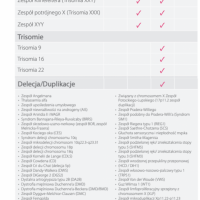
Poszerzone wersje testów NIFTY oferują dodatkowo badania pod kątem aneuploidii chromosomów płci (Zespół Turnera, Zespół Klinefertera, Zespół potrójnego X i Zespół XYY) oraz Trisomii 9, 16 oraz 22. Ponadto możliwe jest wykrycie kilkudziesięciu powikłań będących efektem delecji lub duplikacji chromosomalnej, mogących prowadzić do psychicznych i fizycznych upośledzeń dziecka.

testy NIFTY są także metodą potwierdzenia płci dziecka, która w porównaniu z USG, nie zawsze dającym jednoznaczny wynik, jest o wiele bardziej efektywna i równie bezpieczna. 

Opcje testu


opcjetestunifty 


Dlaczego warto?

testy NIFTY zalecane są przede wszystkim w przypadku osób w ciąży niosącej ze sobą wyższe ryzyko wystąpienia choroby genetycznej. Dotyczy to przede wszystkim matek w wieku powyżej 35 lat oraz osób mających w rodzinie historię zaburzeń na tle chromosomalnym. Również w przypadku podejrzenia jakichkolwiek nieprawidłowości w rozwoju dziecka wykrytych podczas innych badań (takich jak USG, przesiewowy test surowicy czy pomiar przezierności karkowej), test NIFTY może być pomocny przy potwierdzeniu diagnozy.

testy NIFTY są również polecane osobom nie będącym w grupie szczególnego ryzyka i nie mających podejrzeń nieprawidłowego rozwoju ciąży.

Będąc metodą całkowicie nieinwazyjną, testy NIFTY są jednocześnie niezwykle skuteczne. Ich wykonanie może odpowiedzieć na pytania dotyczące ryzyka chorób, uspokoić przyszłych rodziców na temat stanu zdrowia ich dziecka czy ewentualnie przygotować ich wcześniej na konieczność wdrożenia dodatkowego leczenia już w ciąży lub po porodzie.
Ciąża powinna być dla kobiety wspaniałym przeżyciem. Jest jednak również wielkim wyzwaniem dla jej ciała i czasem szczególnej troski o zdrowie własne i dziecka. testy mogą pomóc w odpowiedzi na dodatkowe pytania dotyczące ciąży ale również oszczędzić wielu obaw i niepewności. Zdrowie psychiczne, spokój, poczucie bezpieczeństwa jest dla kobiety ciężarnej niezwykle ważne. testy NIFTY stają się więc jedną z coraz powszechniejsze i stanowią oczywisty wybór pośród podstawowych badań prenatalnych.

I am pregnant during a pandemic. What risks await women in this state, does the virus penetrate the fetus, what happens when a pregnant woman becomes ill with covid? Does passing COVID-19 disease risk miscarriage?

COVID-19 is a new disease that humans encountered late last year-the first cases of coronavirus infection. The disease is caused by the SARS-CoV-2 virus, which can successfully mask itself in the body and spreads rapidly. Its symptoms are not entirely clear, as the virus can have a different set of symptoms in different people, and in some cases develop asymptomatically. Unfortunately, despite intense research into the new disease due to the pandemic it caused earlier this year, little is actually still known. How does the SARS-CoV-2 virus affect pregnancy and are pregnant women more likely to be infected?

Coronavirus and pregnancy - the risks 

According to data in the RCOG-Coronavirus (COVID-19) Infection in Pregnancy briefing from June of this year, pregnant women are not at increased risk of contracting the disease. According to observations, COVID-19 is not transmitted via the transplacental route from mother to fetus. However, it is important to note that pregnant women, due to changes in the immune system during pregnancy, may be more susceptible to viral illnesses and undergo them more severely. 

People who suffer from chronic diseases, which can also occur in pregnant women, will be in a higher risk group. For this reason, people who suffer from cardiovascular diseases, respiratory diseases, diabetes or obesity should be on their guard and be monitored by the doctor who is conducting the pregnancy. People with these conditions are at increased risk for complications and hospitalization if they become infected with COVID-19

Effects of coronavirus on the fetus 

The results of observations and studies performed to date do not support the theory of prenatal or perinatal transmission of infection to children in women infected with SARS-CoV-2. There is no confirmed information on transplacental transmission. However, recent studies have hypothesized the possibility of vertical transmission, but this theory is not fully confirmed. Studies of cord blood, placenta, and amniotic fluid have shown the absence of SARS-COV-2 coronavirus, which means that the period of development and delivery does not pose a threat to the child in women infected with COVID-19. This means that breastfeeding does not pose a risk to infants because the newborn will not be infected this way. However, it should be remembered that the sample in each case is not fully reliable, as the disease is a relatively new case and the number of cases studied is insufficient to draw a definitive conclusion.

There is no confirmed information on the effect of coronavirus on miscarriage issues. However, it is not impossible that the course of the disease may have an effect on premature birth, miscarriage or consequent disorders in the child. The newborn may suffer from kidney failure, disseminated coagulation syndrome, as well as low birth weight. The risk is due to the symptoms that can accompany the development of the infection and lead to complications related to the course of pregnancy. The most common are the condition of elevated temperature and infections. The greatest risk appears to be during the first twelve weeks of pregnancy, when the baby's organs are forming. During this time, any teratogenic agents are at risk, which include but are not limited to viral diseases, biological agents, chemical agents, and particular medications. These can influence the child to develop birth defects and developmental disorders later on. Coronavirus, and more specifically the symptoms it causes, can be a teratogenic factor. 

However, all cases of miscarriage and fetal abnormalities in women infected with SARS-CoV-2 should not be linked to the consequences of the disease. The population risk in healthy cases varies between 12-25% (percentage of spontaneous miscarriages). According to the population risk theory, about 2-3% of newborns are born with malformations. Nearly 60% of miscarriages are the result of a chromosomal aberration in the fetus and not the result of a viral disease or other infection. For this reason, it is difficult to determine whether complications during or at termination of pregnancy are directly attributable to SARS-CoV-2. There are data published by Asian countries that indicate that when a pregnant woman is symptomatic for COVID-19, the most severe complication for the newborn is circulatory failure or cardiac arrhythmias.


Childbirth during coronavirus

The management of delivery in the face of COVID-19 disease is determined in each country according to World Health Organization (WHO) guidelines. Women infected with SARS-CoV-2 can deliver by either method, either naturally or by cesarean section. The decision should still be made primarily on the basis of the woman's clinical condition and the baby's condition. According to WHO data, the baby should not be separated from the mother after birth; on the contrary, the contact between the mother and the newborn should be permanent, close. A woman can breastfeed. However, it is recommended that the child of a mother infected with coronavirus be isolated from other children for safety. Above all, proper sanitary-epidemiological precautions should be taken both in the contact of the staff with the child and the mother, and in the bonding between the mother and the infant. Currently, before the planned date of delivery, one should visit the hospital to have a test for the presence of genetic material of the virus or antibodies to SARS-CoV-2. Our hospital is one of the few offering a quick test and results using both the PCR method and the immunochromatographic method. The test will allow to confirm or exclude coronavirus infection, giving information both to the parents-to-be as well as the medical staff on the choice of appropriate sanitary conditions during childbirth and further stay in the hospital. 

Pregnancy safety in the era of coronavirus 

For pregnant women who are not infected with coronavirus, it is important to stay safe and exercise caution. Adhering to the restrictions associated with the outbreak, such as keeping a social distance and covering your mouth and nose in public spaces, will help here. If possible, it is advisable to keep public spaces to a minimum for the duration of the pregnancy, preferably until the outbreak is over, or at least until the pregnancy is successfully terminated. Both healthy and infected women should be under the constant care of the doctor in charge of the pregnancy. Beyond physical health, however, it is also important for pregnant women to stay calm and try to think positively. Stress in pregnancy is not good for a pregnant woman's mood and psyche and can have a negative impact on the pregnancy itself. For pregnant women who have been confirmed to be infected with coronavirus, the main thing to do is to prevent a state of elevated body temperature from persisting. This is especially important for women in the first trimester of pregnancy. 

Women who have a suspicion of being infected or who have had contact with a person suffering from COVID-19 should immediately contact the doctor in charge of their pregnancy or the NFZ helpline, which will provide them with the necessary information and methods of action in their particular case. This is especially important for pregnant women who have alarming symptoms that may indicate the presence of SARS-CoV-2 in the body. A quick response is a guarantee of an appropriate path on the way to preventing the development and appearance of complications for the course of pregnancy. A woman should inform the doctor in charge of the pregnancy of any abnormalities and alarming symptoms she notices and follow the recommendations strictly. It is worth remembering that direct contact is not always required, and sometimes only telephone or e-mail contact is sufficient. The doctor will be able to assess the need for a visit for the condition of the woman so as to minimize the risk. 

However, it is not only the pregnant woman who should be self-aware of her condition and the need for caution, but also her surroundings and loved ones. This means that co-habitators should not put the pregnant woman at risk for infection. If possible, both the pregnant woman, the household members or the medical professionals caring for her should be tested for SARS-CoV-2. 

The SARS-CoV-2 coronavirus is a new strain of virus to deal with and still requires research to understand its nature. Unfortunately, the findings to date are more like circumstantial evidence and recommendations than definitive conclusions about the disease. This is especially true when considering the impact of coronavirus on pregnancy development. The number of investigated cases of pregnant women infected with COVID-19 is not yet a sufficient sample to make a definite conclusion. However, studies continue to be conducted to develop appropriate standards of management and prevention over time.

Source:

  • A. Lamouroux, T. Attie-Bitach, J. Martinovic, M. Leruez-Ville, Y. Ville, „Evidence for and against vertical transmission for severe acute respiratory syndrome coronavirus 2”.
  • Coronavirus disease 2019 (COVID-19) pandemic: increased transmission in the EU/EEA and the UK –seventh update 25March 2020.
  • Huijun Chen, Juanjuan Guo, Chen Wang et al. Clinical characteristics and intrauterine vertical transmission potential of COVID-19 infection in nine pregnant women: a retrospective review of medical records Lancet 2020; 395 (10226): 809-815.
  • J. Tulimowski , „COVID-19 w ciąży zalecenia”.
  • Rasmussen S.A., Smulian J.C., Lednicky J.A. et al. Coronavirus Disease 2019 (COVID-19) and Pregnancy: What obstetricians need to know ACOJ 2020 in press.
  • Rekomendacje Sekcji Ultrasonografii Polskiego Towarzystwa Ginekologów i Położników, dotyczącymi badań ultrasonograficznych w zakresie położnictwa i ginekologii w obecnej sytuacji epidemiologicznej, publikowane w celu minimalizacji ryzyka transmisji infekcji COVID-19. 
  • WHO „Coronavirus (COVID-19) Infection in Pregnancy” –  Royal College of Obstetricians & Gynaecologists.
  • Zalecenia Konsultanta Krajowego w dziedzinie perinatologii oraz Konsultanta Krajowego w dziedzinie położnictwa i ginekologii odnośnie organizacji pracy oddziałów położniczo-ginekologicznych w sytuacji epidemiologicznej związanej z ryzykiem zakażenia wirusem SARS-CoV-2. 

Kontakt

ul. Dworska 1B, 30-314 Kraków
rejestracja@dworska.pl


Szpital Dworska - Kraków

Opening hours

Monday:
7:30 - 20:30
Tuesday:
7:30 - 20:30
Wednesday:
7:30 - 20:30
Thursday:
7:30 - 20:30
Friday:
7:30 - 20:30
Saturday:
7:30 - 14:00
Sunday:
Closed
lokalizacja parkingu

Parking next to Dworska Hospital - entrance from the Bułhaka street